

The Meaning of the Colour Yellow
Introduction
The colour yellow is found somewhere between green and orange on the spectrum of light. In the RGB colour model, yellow is a secondary colour made by combining red and green, allowing it to be transmitted to television and computer screens. In the CMYK colour model, it is a primary colour. Carotenoids are yellow, orange and red pigments produced by plants and make yellow a common colour in nature. It’s found in corn, carrots, daffodils, autumn leaves, lemons, bananas and many more. One of the most common associations with the colour is that of sunlight, which gets its yellow hue from atmospheric scattering of shorter wavelengths (colours like green, blue and violet).
Because the colour is found in abundance in the natural world, it has been available as a colour pigment for most of human history and is among the first colours used. Derived from yellow ochre, a cave painting in Lascaux, France, of a horse has been dated to 17.000 years ago.
The English word yellow is derived from the Old English word geolu, which in turn can be traced back to the Proto-Germanic word gelwaz. It shares its roots with the Indo-European base gel- like the words gold and yell. Meaning bright, gleaming and to cry out. The word yellow is related to other Germanic words like German gelb, Scottish yella, Dutch geel and the Swedish, Danish and Norwegian gul.
The complementary colour of yellow is purple according to colour theory tradition, as the two are opposites on the RYB colour wheel. According to Newton’s colour circle, yellow is directly opposite the boundary between indigo and violet. Leading to a lot of discussions and debate as to what colour is truly complementary to yellow. Different pigments have different characteristics and different hues, as well as the different colour wheels used, which have led painters to regard yellow to be complementary to indigo or blue-violet generally. Another widely discussed topic in regards to yellow is its symbolic meaning.
Across the globe, yellow carries different meanings. According to surveys in Europe, Canada and the US, people mostly associate the colour with amusement, gentleness, humour, happiness and spontaneity, but also envy, jealousy, greed, justice and in the English-speaking world: cowardice. In Iran, it has connotations of sickness but also connection and wisdom. In China and many Asian countries, it’s a colour of nobility, royalty, respect, happiness, glory, harmony, as well as wisdom. Across cultures, it’s typically associated with the sun as well as gold, and because of this, it's also associated with well-being, wealth and generally good things; despite this, it’s generally considered “ugly” by a lot of people in the West.
In a survey from around 2000, only 6% of respondents in Europe and America named it their favourite colour, far below the 45% that said blue and even below the 10% that said black, making it one of the least favourite. For 7% of respondents, it was their least favourite colour. In medieval Europe, because of the negative association with yellow, yellow hair was often referred to by other names like “blond”, “fair”, “light” or “golden”. Perhaps the reason yellow is such a divisive colour is because of its striking nature.
As a colour, yellow is the most visible colour from a distance, and as such is often used for objects that need to be seen. Like road signs, road maintenance equipment, school buses, taxis and many more. While red is associated with danger, yellow is associated with caution. In football, a yellow penalty card means a warning but not expulsion. Like most colours, yellow has both positive and negative associations, and these associations have changed throughout history and have varied between cultures.
In Culture
To the Ancient Egyptians, yellow was associated with gold, a material the Egyptians considered indestructible and eternal. They believed both the skin and bones of the gods were made of gold, and they used yellow extensively in tomb paintings. The use of yellow for skin colour would continue with the Romans, who made use of the colour in their murals. The Egyptians used either yellow ochre or the rich pigment called orpiment, made from arsenic and highly toxic. A small paintbox filled with orpiment pigment was found in the tomb of Tutankhamun.
The lavish colour continued to be popular throughout the Roman Empire and was equally well-liked by the Byzantine Empire. With early Christianity, yellow received new meanings and associations. In the Post-Classical period, yellow became the colour associated with Judas Iscariot, the disciple who betrayed Jesus, despite there being no official mentions of his clothing in the Bible. Because of this connection, yellow started being associated with envy, jealousy and duplicity as well as betrayal. This connotation would later be reinforced when, in the 16th century, the Spanish Inquisition would dress heretics in a yellow cape.
Because of the colour’s close relation to gold, it has always been associated with wealth, finances and moneylenders. St. Nicholas, the patron saint of pawnbroking, is often depicted holding three bags of gold in his hand. Because of how expensive gold was, saffron would sometimes be used to colour pages in medieval manuscripts, replacing the need for expensive gold leaf for illuminated manuscripts. In Asia, turmeric was for a long time used to dye clothing - especially monks’ robes. Saffron was also used, but significantly more expensive. The yellow robes worn by Buddhists were defined by the Buddha himself. To Buddhists, the robe and its colour are a renunciation of the outside world and commitment to the order.
Yellow pigmentation was made from a variety of natural resources, including arsenic, cow urine, plants and tubers, and in the 18th century, yellow pigments and dyes began to be synthesised and manufactured on a larger scale. This saw a surge in the colour’s popularity with painters, especially in the 19th century. Vincent van Gogh was famously very fond of the colour, and some of his most notable work contains the colour. He was also among the first artists to use commercially manufactured paints.
In the 20th century, yellow was particularly valued as a colour of high visibility. In Nazi-occupied Europe, Jews were forced to sew yellow stars of David on their clothing, making them easy to differentiate and spot in a crowd. Because of yellow’s ability to be viewed from great distances and high speeds, yellow makes for an ideal colour to signal to car drivers. This fact also led it to be incredibly popular in neon signs in Las Vegas and in China. Yellow has throughout the ages been a colour with strong historical and cultural associations in China, where it still to this day is the colour of happiness, glory, wisdom, virtue and nobility.
After the Song dynasty, laws were implemented that banned the use of certain yellows by anyone except for the emperor. Distinguished visitors to the palace were honoured with a yellow, not a red, carpet. According to legend, the very first emperor of China was called the Yellow Emperor. The emperor of the Chinese Empire was ordained by heaven, and the colour yellow was associated with this celestial birthright, as a light from heaven shone upon the intellect of the emperor.
As the colour associated with light, it’s also associated with knowledge and wisdom in many cultures. In many languages, terms like “brilliant” and “bright” mean intelligent. In many European universities, yellow remains a symbol of reason and intellect, and yellow gowns and caps are worn by members of the faculty of physical and natural sciences. Yellow is somewhat rare in fashion, but yellow dresses are associated with happiness and celebration. Yellow as a colour is commonly associated with optimism, joy and warmth.
A yellow room, or a room lit up by a yellow lamp, is often experienced as warmer and more welcoming than white rooms or white light. The colour is cheerful and energetic, it amuses and inspires and brings to life the entire world, both metaphorically and literally, in terms of our yellow sun shining down on us. It has many positive associations but also some negative ones. Like betrayal, cowardice, envy and jealousy. It’s commonly associated with the sun and gold, and it’s a warm and rich colour that is very good at drawing attention to something, like a ray of sunlight shining into a dark room through the window. Let’s take a peek through it and discuss the colour’s importance in my own work.
In My Work
Yellow is found in my work, and often as a colour of light and gold, and having grown up in a yellow house, I’ve always had more positive connotations with the colour than negative, but it’s not a personal favourite of mine. In my paintings, I enjoy yellow mixed with white to create a light lemon shade, highlighting the light qualities of the colour and combating its weakness. Yellow pigment is notoriously weak, and a lot of yellow colours require several layers to really create a brilliant yellow.
I like to work with a black canvas, or generally a dark background, and yellow is wonderfully visible against such a dark scene. It allows the colour to really draw the viewer’s eyes to specific points of interest. In my work, the radiant yellows often represent the sun and the symbolism associated with that: radiance, glory, truth and so on. Aureated and shining, it serves as a spotlight showcasing whatever instrument is necessary for the scene to convey its full message.
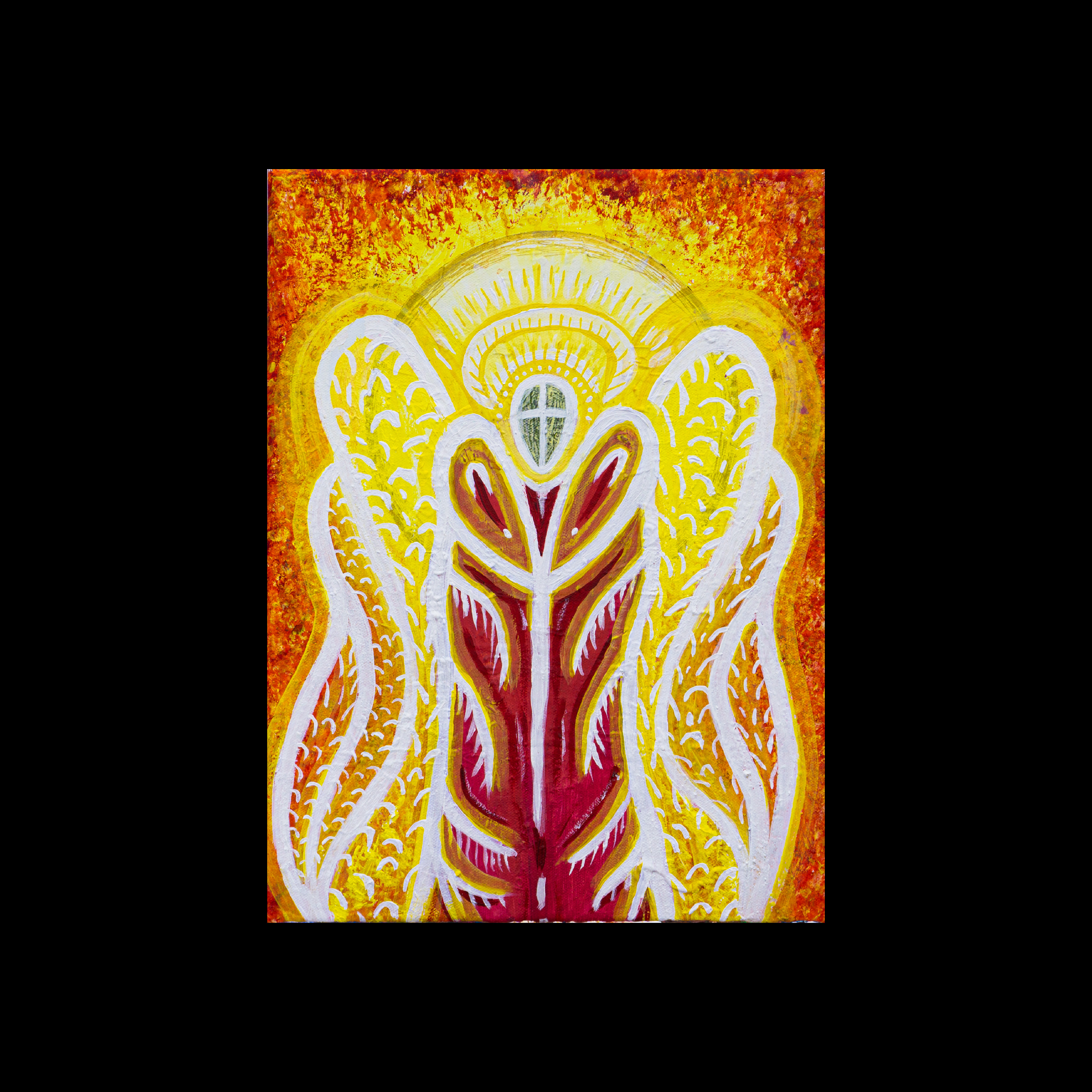
I think yellow goes wonderfully with red; perhaps it's the golden qualities or the warmth of the two colours, nonetheless, yellow softens a red and makes it much less intense, much less aggressive and more hospitable. Yellow is mellow and a wonderful colour.
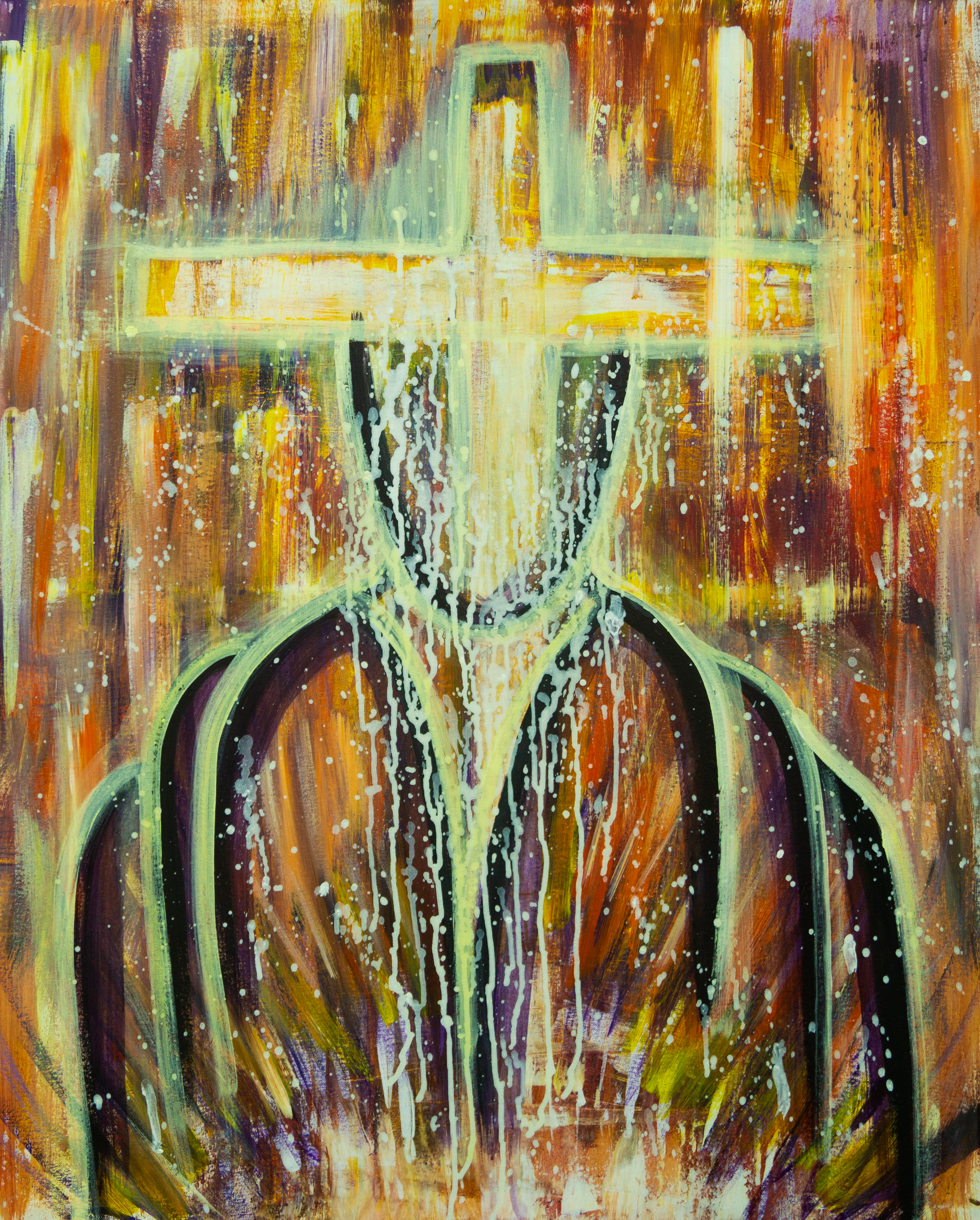
Yellow appears in a lot of the portraits I do, where it symbolises a light found in each person. Highlighting human reason and knowledge. It lights up paintings and can bring attention to things we sometimes forget or do not think about. There’s a sun in every person, and no matter the amount of darkness, a piece of that sunlight shines through the eyes, illuminating the surroundings.
Yellow is a multifaceted colour that can mean a lot of different things to different people, and sometimes the negative connotations colour our view of the hues. For me, yellow remains a largely positive colour, and it’s sure to stay in my art.


