
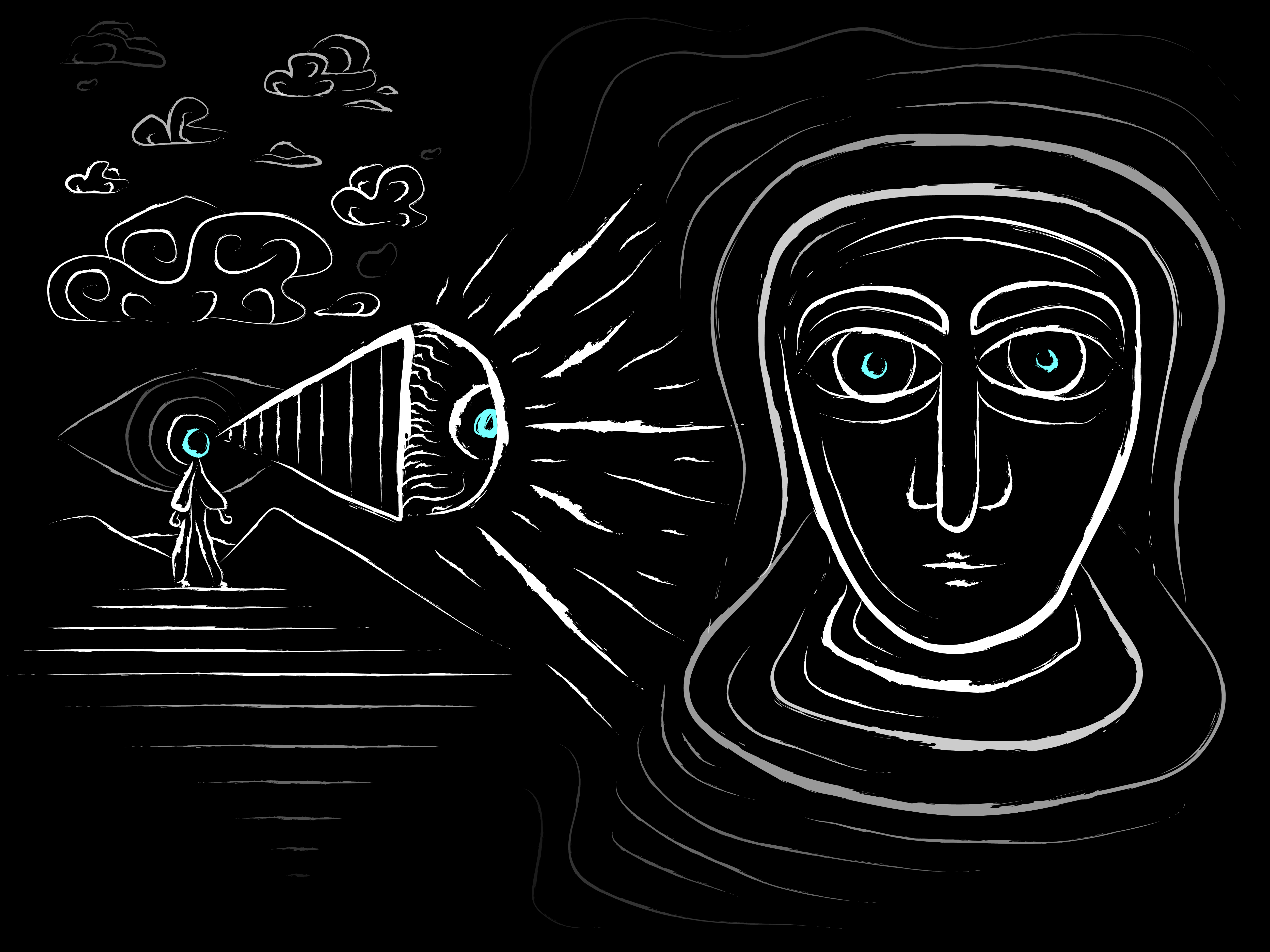
The Art of Self-Perception
Introduction
Art is about communication, both to others and with the artist themself. One of the most important aspects of art is this inner communication. Art is often self-reflective and contemplative on at least some fundamental level, and this is what makes it so ironic that a lot of artists struggle with self-perception. Either as an overinflated ego or as a completely compressed and undervalued sense of self. For the sake of art, and maybe even life at large, it’s important to develop these introspective qualities, and to do so without skewing too much to either extreme.
This essay will look at both sides and discuss how to find a balance between them. Seeing yourself for what you are, is a very tricky thing. A fun little thing you can do is try to look yourself in the eyes in the mirror. It’s not as easy as it sounds, because to truly meet your own gaze, you have to look slightly beyond yourself. Mirrors are also not good metaphors, because they reflect you in an opposite kind of way, which is believed to be the reason why a lot of people find photos unflattering, because we’re so used to seeing only our mirrored self.
We’re not talking about physical self today, however, and instead we’re talking about our essence, as people, as creatives and as artists. Focusing especially on that last part, and doing so, we’re looking at not only how we perceive ourselves but the work we do. The work being an extension of the artistic self. To truly fill the role of an artist, one has to hold a balance within oneself of what one is; this means understanding that one is not the greatest to ever live and not the worst to have picked up the trade.
You need to understand yourself and understand your own value without overinflating it, because if you don’t, your intrinsic motivation will be very low, and you will be discouraged from doing your work. If your pride is too great, however, you will be discouraged from putting in the needed effort for good work, and you will undoubtedly bring about your own downfall.
First, let’s talk about what the art of self-perception is and why it’s important, especially when it comes to art.
The Art of Self-Perception
The ability to view yourself as objectively as possible is a difficult thing; there are several mental aspects that get in the way of allowing us to see ourselves for who we truly are. This might be especially true for creatives, whose brains function in a slightly different way and are structured differently from others. Creatives listen to unusual music, come up with unusual ideas, and view the world from a place of personality, which is characterised by an openness to experience.
This trait can also make you view yourself in a less static kind of way, and like a funhouse mirror, the sense of self can be warped and distorted. While some schools of thought insist there is no self, and that the perception of one is only imaginary and illusory, this imagination is so persistent with the rest of our cognitive conception of reality that it can’t really be applied to the frame of mind most artists operate from.
Because it’s not a matter of what’s true and what’s not, that is irrelevant to an artist and even creatives; what matters is the sensory perception of a reality which the individual experiences, interacts with and then communicates through interaction with it. It is entirely irrelevant whether what is real and what isn’t - that line for an artist is always blurred, and it has to be to be able to develop such a strong sense of imagination. Between these two worlds, the artist simultaneously creates their reality and has it inflicted upon themselves by an outside force.
Perceiving the self or not perceiving it is a matter of individual preference for creatives. Like all other things real and not real, it can be reinforced and it can be diminished. The state of flow required and sought after by artists is largely selfless, and the sensory perception of first-person “I” doing is often completely dissipated; this act is not much different from zen meditation, but just as a zen master needs his ego to sell his classes to westerners, pay his taxes or collect alms, so the artists needs the same to survive in the world. The ego and sense of self are fundamental to operating in this reality.
You can leave them by the pavement now and then and probably should, but there are plenty of times when you need them. If you don’t have a sense of self, you don’t know which mouth to put the spoon to. When you need it, you should be able to view yourself from an outsider perspective in a compassionate and somewhat neutral way. Leaning too much towards either complete self-love or self-hate is not good. This, like most things in life, is a balancing act.
Creative people need to ground their self-perception, because when you have a highly imaginative mind, it’s easy to view yourself in all kinds of untruths. You can make yourself larger or smaller than you are, and this distortion can be towards both positivity and negativity. This sense of self is a little more fluid and dynamic for most people, and it is important to remember this, especially when the self inflates its own value.
Artistic Pride and Narcissistic Self-Glazing
“Success is born out of arrogance, but greatness comes from humility.” - Marco Pierre White
Pride and arrogance lead to downfall; it’s been true since biblical times, and it continues to be true today. The examples are all around you; the thieves that get caught are the most brazen ones, the ones that think they’re too smart to be caught. Public figures who inevitably ruin their careers think they can get away with anything, but eventually it all catches up with them. It might take a little while, but sooner rather than later, what is done in the dark will come into the light. More importantly for artists, however, is the irreparable damage this kind of pride can cause to the artistic work.
When the ego overvalues its own talent, skill or value in general, then we create art from a place of “this work is good because I did it” and not because of its own intrinsic value. It makes us complacent, lazy and blind to faults and mistakes. Beyond that, we become sensitive to critique, and we don’t take feedback, something which is necessary for growth and improvement. If we only value our own opinion and no one else's, we become uncompromising, and we lose a lot of perspective and a lot of valuable information. No one is all-seeing and all-knowing; it’s a limitation of humanity, and no matter how hawk-eyed and keen-minded we are, we can miss things.
Another thing about inflated egos is that they’re like balloons; they’re thin-skinned and easily burst at the first sharp resistance they meet. It’s necessary to be empty and full of air to float above everyone else, but as soon as something goes wrong, these minds are the first to come crashing down. We often wrongly associate these people with being strong-willed and confident, but the truth is, they’re often gaslighting others and themselves, warping truth and reality to protect their fragile reality from imploding. It’s a dangerous state of mind to be in, because while you may get away with it for a long while, eventually it catches up, and when it does, you lack the necessary tools to deal with it.
Humility builds strength, accountability builds perseverance and making mistakes is a crash-course in success. The warped sense of self which views itself grander than it could be will throw a tantrum when it can’t reach the top shelf. It tries to make itself bigger by making the world and the people around it smaller. The inflated ego works less and creates art of lower value. Spiritually, philosophically, morally, aesthetically and creatively. Because it’s made these qualities so small and insignificant that it towers above them.
The other side of the coin is the self, which makes itself smaller to make the world around it seem larger, and it brings about a unique set of challenges and problems.
Insecurity & Undervalued Sense of Self
We can not only suffer from an inflated sense of self, but also from an underdeveloped sense of self. This is when we think we’re less valuable and important than we are. It means insecurity, crippling self-doubt and co-dependence on others. This leads to a plethora of artistic problems. Doubt and insecurity make you uncertain, and uncertainty makes you postpone, procrastinate, and avoid work. This can lead to escapism and flat-out not creating art.
More than creative blocks or hinders, this kind of view on the self leads to hostility towards yourself and your work. It’s gone far beyond the self-limitations of humility and has once more become delusional, thinking itself utterly worthless, and this artistic apathy is the death of many works of art.
To create art, you have to be confident and trust in yourself, and in the process, this kind of incapacitating doubt stops you dead in your tracks, or worse, it completely stops you from even starting an artistic project. More often than not, we are our own worst critics.
When this criticism is too harsh and doesn’t come from a place of well-meaning introspection and a compassionate point of view, it can make us feel filled with contempt for ourselves and all that we do. Nothing is ever good enough, and improvement seems impossible. All work is futile and meaningless, and this can extend to problems far beyond creativity.
Creativity requires openness, but when we undervalue ourselves, we shrink down, and we close ourselves off to the world. We don’t allow ourselves to feel safe in our own heads, and we immediately shut down unusual ideas as being too strange or not worth remembering. This twisted self-perception makes every good quality and trait we have into something horrible, something which should be locked away and preferably not interacted with.
We think this is a safer way to interact with the world, that if we hide our self; that we can’t be hurt. That if we don’t try, we can’t fail, and that no matter what we were to do, it would never amount to anything meaningful. Just as we have to humble ourselves to avoid pride, we have to ground ourselves in reality, to lift ourselves up from underground and claim our place in the sun. The sun dispels these illusions, and it allows us to clearly see the self for who and what it is. We should not fly too close to it through arrogance, and we should not hide away in a burrow of doubt.
Overcoming Distorted Self-Perception
How do we become confident but not overconfident? How do we humble ourselves without completely neglecting our own value? Is there a balance we can find between complete self-annihilation and delusional self-grandeur? How do we ground ourselves in truth and see ourselves not from a place of ego, nor from a place of self-hate? These are tricky questions, and the truth is that our sense of self is fluid and dynamic, especially for creative people.
There are so many factors that we have to take into account, and anyone who has lived for long enough knows that age and life experience play a very big role in this. The sense of self and even self-perception are something which is developed and something which you actively have to engage with to change. It’s not as passive a deal as we might be led to believe. When was the last time you took the time to just be alone and think about who you are and what you do? What was that experience like? Was it terrible, was it difficult, or are you just the most perfect human being that exists?
We should be careful not to rely too much on external influence. Compliments are nice, and criticism isn’t as nice, but we have to take both into account. Don’t let compliments inflate your ego and determine your self-worth, and simultaneously take criticism for what it is: insecurity and negativity projected onto you, or well-meaning and helpful advice. Learning to discern what is what only comes with experience, so don’t be afraid to change your mind and be open to understanding yourself in a bigger picture than you do currently.
Anchor yourself in the middle path, and always try to do your best work. Engage with art and creativity openly and engagingly, not as a static evaluation of yourself. Think about what you like and don’t like, and try to see things from the other side as well. It will expand your understanding, but don’t be so open-minded that you let others decide for you. Carefully listen to others and don’t compare yourself; not everything is hierarchical. It’s not a competition of whose argument is right; try to understand their point of view, and express your own thoughts without inner judgment.
Understand your place in the world, not as the greatest, most important person to have ever lived, and that all others are here to serve your will, and your will alone, but also not as an insignificant ant whose life could be squashed and it would make no difference. You’re somewhere in between - you’re human. Not perfect, and not worthless, both of these are lies of the enemy of your soul.
Lose yourself in the artistic process, and be egoless for a little bit, enjoy that flow and enjoy the silence of your mind; that peace is divine, but don’t get lost there. Understand that you’re complex, multifaceted and have the potential for both good and bad. Discern between the two, and don’t judge yourself too harshly; that’s not your job. Others may view you differently than you do, so take the time to take a good look at yourself and decide for yourself who and what you are.
Final Words - The Similitude of Embroidery
The artist views themself and their work from the inside, whereas outsiders view it from the outside. Consider a beautiful piece of embroidery; from the outside, it's clean and neat, lines of thread perfectly symmetric and beautiful. The inside of the fabric, however, reveals a tangled mess of connections the outsider typically doesn't see. You are that piece of embroidery, that textile artwork; there are lines across your soul that only you can see, and the self others see is different from how you view yourself. So don’t be too quick to judge yourself. You’re beautiful, and you’re a mess; it all depends on perspective.
Creatives tend to have a different perspective on things, and this applies to themselves as well. This perception can become warped and distorted, and it can lead to two different pitfalls: pride and insecurity. We have to use the art of perception to get a better picture of our own self, and to understand ourselves more holistically than as either a number 1 or a 0.
The truth is somewhere in the middle; it’s important to recognise both flaws and skills in ourselves. Avoiding either extreme and finding a balance between the two polarities. We are neither perfect nor immaculately flawed.
To avoid falling into either pitfall, we should ground ourselves securely, with confidence and self-knowledge. It’s important to take the time for self-reflection to avoid being fooled by delusions and warped self-images. Listen to outsiders; they provide a valuable perspective, but don’t let them dictate your reality. The art of self-perception is a tricky thing, and it takes time and life experience to fully grasp the fullness which makes you, you.
One of the greatest privileges in life is becoming who you are.


