
What is Survivorship Bias?
Why We Focus on Success Stories
Survivorship bias applies to a lot of different domains, and we can easily fall into this logical error in almost any aspect of our lives. This bias occurs when we focus solely on successful outcomes and completely ignore failures, which leads to prejudice and to inaccurate conclusions. It can distort our decision-making, skew our perception and ultimately make us execute flawed strategies. If we ignore failures, we can become overconfident and overestimate our chances of success.
As the name implies - survivorship bias implies that we only look at the data of the “survivors” or successes. It’s a common bias because we tend to overlook failures, and, in many ways, they're less visible. Successes are celebrated, documented and more likely to be remembered and cherished. Nobody likes to acknowledge their shortcomings, and so we tend to hide them from others, discard them, or suppress them even from ourselves.
We also tend to focus on success stories because they’re more inspiring and emotionally satisfying. Who doesn’t love a good underdog? We want the little guy to succeed, and we want the human spirit to overcome whatever seemingly impossible odds it’s up against. As a result, we tend to overlook the more common, and often more instructive cases where choices, strategy or chance led to failure.
There are some ways we can prevent this bias from clouding our judgment, but first, we have to understand how ignoring the whole picture can have an impact on our personal judgment, as well as business or life decisions.
The Impact of Survivorship Bias
The bias creates unrealistic standards. We often hear about the ones who “made it”, but rarely hear from the many who did everything in their power and, despite it, didn’t succeed. We also rarely hear about the failures the success stories endured, often choosing to focus on the positives or to flat-out cover up their failures so that they may seem larger than life.
People may believe that dropping out of school is a way to success because they see the stories of famous people who did just that, or they may assume that addiction is a necessary, difficult stepping stone in a creative career, hearing tall tales about recovering addicts who struggled for years during their most creative time. What these people don’t know about is the people who dropped out of school and struggled, or about the people who never recovered from addiction, and perhaps ultimately met an early end.
You hear about get-rich-quick schemes and startups that all managed to make millions, through sheer grit and elbow grease, but you rarely hear about the ones that never financially recovered from their decisions. Equating life to pure chance or pure willpower is equally foolish, and ignoring the other side gives you only half a picture.
Challenges can be overcome, and you can work yourself to success. You can also be lucky or unlucky; ultimately, you can only control what you can influence, and that influence is going to be decided on how informed and perceptive you are. When decisions are based solely on visible outcomes, we tend to overestimate the effectiveness of certain actions or strategies. It can lead us down paths that seem more promising than they actually are, or we adopt beliefs that are only valid because they’ve filtered out failure.
Realising what is missing, and not focusing on what is visible at the surface, is key to making more balanced, realistic and better decisions. Don’t overestimate yourself or your ability, don’t compare yourself to others, and do your work diligently.
Survivorship bias is common in many different fields, and close to heart for many creatives with the stereotype of the suffering artist. In many ways, this stereotype is a victim of survivorship bias because no matter how much the artist suffers, in some way, they succeed. Van Gogh is a success because he’s one of the most recognisable painters of all time, despite his personal hell. We hear about the success stories of the creatives who endured abuse, addiction, and so much more and worse, and in many ways, it gives us the expectation that we can and should endure it for success.
In life, you will have to make sacrifices, but exactly what you’re willing to sacrifice and can endure is something you should consider carefully. There’s much more to life and art than fame and success, and for every artist who endured hell and made it out, there are many more unnamed and forgotten who drowned in that dark abyss.
To make the best decision you can make, you should seek out the full picture, and you should widen your understanding of what something entails before betting your life on it. Understanding survivorship bias and how to prevent it from clouding our senses, we can make smarter decisions in many aspects of our lives.
Preventing Survivorship Bias
There are a lot of cautionary steps we can take to prevent ourselves from falling into this logical fallacy. The first step is always going to be recognising that this bias exists, and we should attempt to recognise it in ourselves when it arises. Furthermore, there are three easy steps we can take to prevent this bias from obscuring our perception of things:
Beware of the Allure of Success Stories
If something sounds too good to be true, it probably is. Success can be tempting and very alluring, and it’s easy to lose sight of things around us when these temptations call our name. Nobody wants to fail, and everyone wants to succeed. These words may hold different meanings to different people, but we still want success, no matter what that looks like to us. This bias is so simple and deeply rooted in us because of it, it’s easy to look away from what we fear or dislike, and always easy to look towards what we want.
To avoid this blindspot in our thinking and decision-making, we should be wary of success stories, especially if they’re sold to us. What do the storytellers gain from us believing in it? What part of the picture are we missing here? We don’t have to be overly cynical and pessimistic about every success story, but we should be encouraged to question and seek out the missing parts.
Seek out Missing Data
When looking at statistical data, consider base rates to understand a more accurate likelihood of success, rather than focusing only on examples of success. Actively looking for cases that didn’t succeed and understanding why they failed provides a more realistic perspective on success. If you understand what failure is, what it entails, you can also come to learn the real price for success.
Seek to Understand Failure
Survivorship bias is about focusing solely on success, as it is as much about ignoring failure. Recognising that failure is real and quite common is part of preventing this cognitive bias. Failure is a necessary step towards success, and while it may be left out of success stories, part of that heroic journey is always going to be setbacks and challenges to overcome.
Understand that what failure and success are are both subjective understandings. Losing several millions to a billionaire might be like dropping a quarter to some, while risking that same amount of money for another could entail losing home, security and even threaten their survival.
Summary
Cognitive biases and logical fallacies dim our minds and can make us commit to ill-informed decisions and take unnecessary risks. Survivorship bias is one of those traps that can be found in many different domains of our lives, and we daily run the risk of stepping into it.
Survivorship bias occurs when we concentrate on entities that passed a selection process or survived their challenges, and ignore or overlook those that didn’t. Incomplete data can lead us to draw incorrect conclusions.
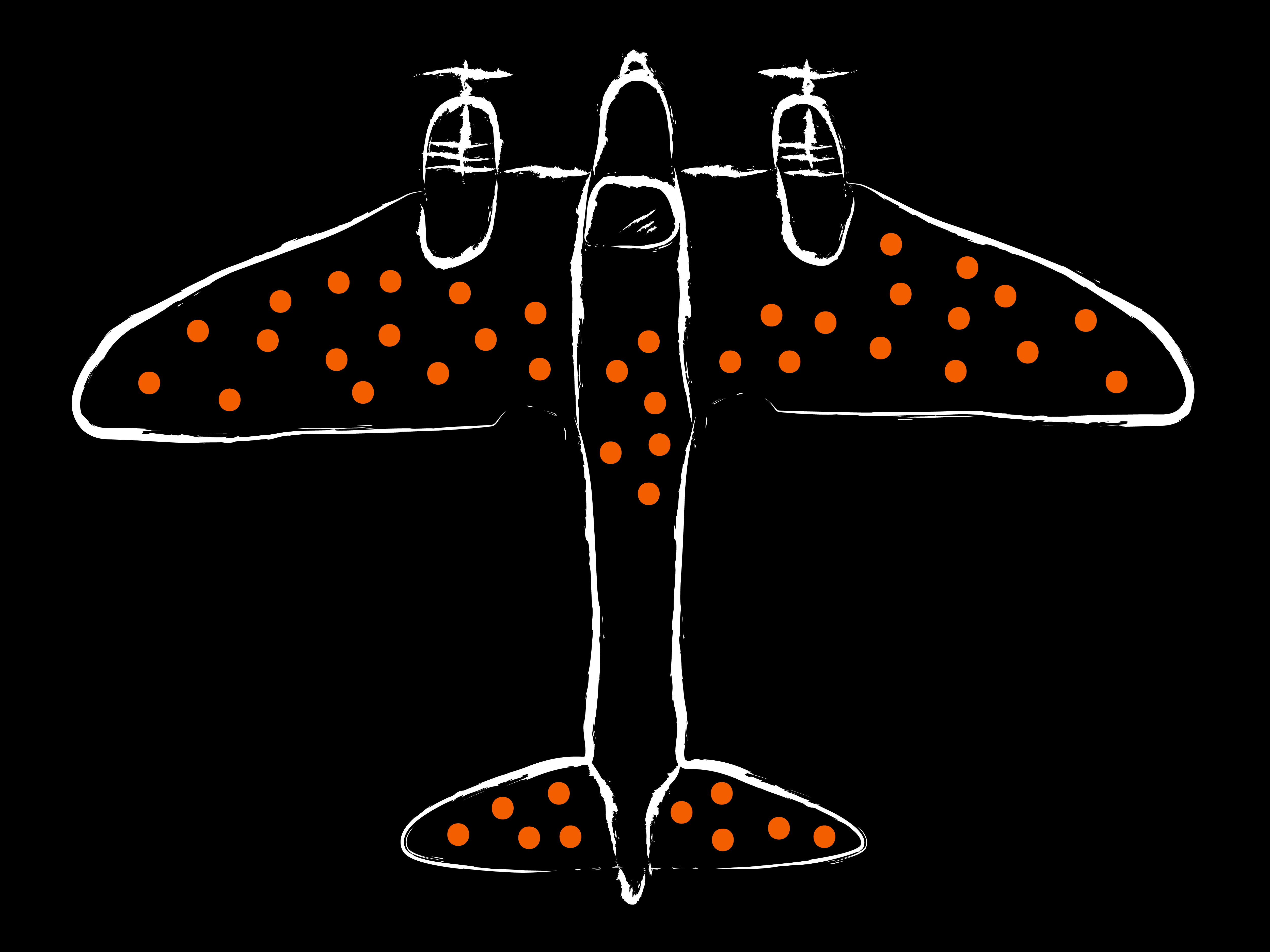
A famous example of this bias is the idea of looking at the damage inflicted on fighter planes. By only looking at the planes that come back, you might draw the conclusion: “We should reinforce these spots because that’s where the planes have taken the most damage”, but this is a misunderstanding of the statistics. Realistically, the parts that would need extra reinforcement are the parts that, when hit, caused the planes to crash. The most hit parts on surviving planes mean they’re not significant for the survival of the plane.
Making decisions without having a full picture can hinder us from making well-informed choices and can lead us down some bad roads. To help give us a better picture of things, we should be aware of this bias and recognise it in ourselves. There are some things we can consider when we look at information. Like being aware of the allure of success stories, seeking out missing data and understanding failure.
Stories we hear often focus on success and ignore failures, but failure is a part of all successes, and it’s important to remember this and to take calculated risks. Not everything is left up to chance, but we also can’t influence every aspect of our lives. Learning from failure can sometimes be more informative and instructive than focusing on success stories.
"Learn from the mistakes of others. Life's too short to learn from only your own mistakes" - Unknown


