
Ideasthesia - How Sensing Concepts Change Our Perception
Introduction - What is Ideasthesia?
Ideasthesia is a neuropsychological phenomenon in which cognitive activation of concepts (inducers) invokes sensory experiences (concurrents) similar to perception. Perception means not only visual, but also of any of the senses. E.g thinking about the concept of the numbers 1-9 can produce a wide array of colours, each associated with a different number. A phenomenon traditionally covered by synesthesia, but there are key differences between the two.
Ideasthesia gets its name from Ancient Greek and can be roughly translated to “sensing concepts” or “sensing ideas”, whereas synesthesia means “union of senses”. Synesthesia implies the association of two sensory elements with little connection on a cognitive level.
Research done has, however, indicated that most phenomena linked to synesthesia are induced by semantic representations rather than sensory properties. The linguistic meaning of the stimulus is thus greater than many might have initially thought. Synesthesia presumes that both the trigger (inducer) and resulting sensory experience (concurrent) are of a sensory nature, whereas ideasthesia assumes that it’s only the concurrent that is of a sensory nature, and the inducer is semantic.
Later on, ideasthesia as a concept has been extended beyond the topic of synesthesia and has developed into its own theory of how we perceive things. Another important aspect of it has been its implication in the theory of art, and could bear important implications in explaining human consciousness, which, according to ideasthesia, is based on how we activate and sense concepts.
Anything cognitive related to semantics and linguistics is tricky to unpack because words and concepts are not static things, and they are about as singular as spider webs. To understand the depth in which ideasthesia deals, we have to understand semantic networks. Then we will look closer at the implications ideasthesia has in relation to art theory.
Semantic Networks
Also called frame networks, are knowledge bases that represent semantic relations between concepts in a network. They’re often used as a representation of knowledge and represent the semantic relations between concepts and functions as a map. Semantics is the linguistic meaning of a word. Typically, semantic networks are expressed through semantic triples. A triple is a sequence of three entities that codifies a statement about semantic data in the form subject-predicate-object expressions. E.g “The sky (subject) has the colour (predicate) blue (object)”.
These networks serve many uses, and can be used to analyse large texts to identify biases, themes and topics and even to map an entire research field. We don’t need to understand them in such a grand way for our purposes. Semantic networks are a great illustration of how our minds work, and especially if you find your mind wandering, it can really map out those seemingly random connections.
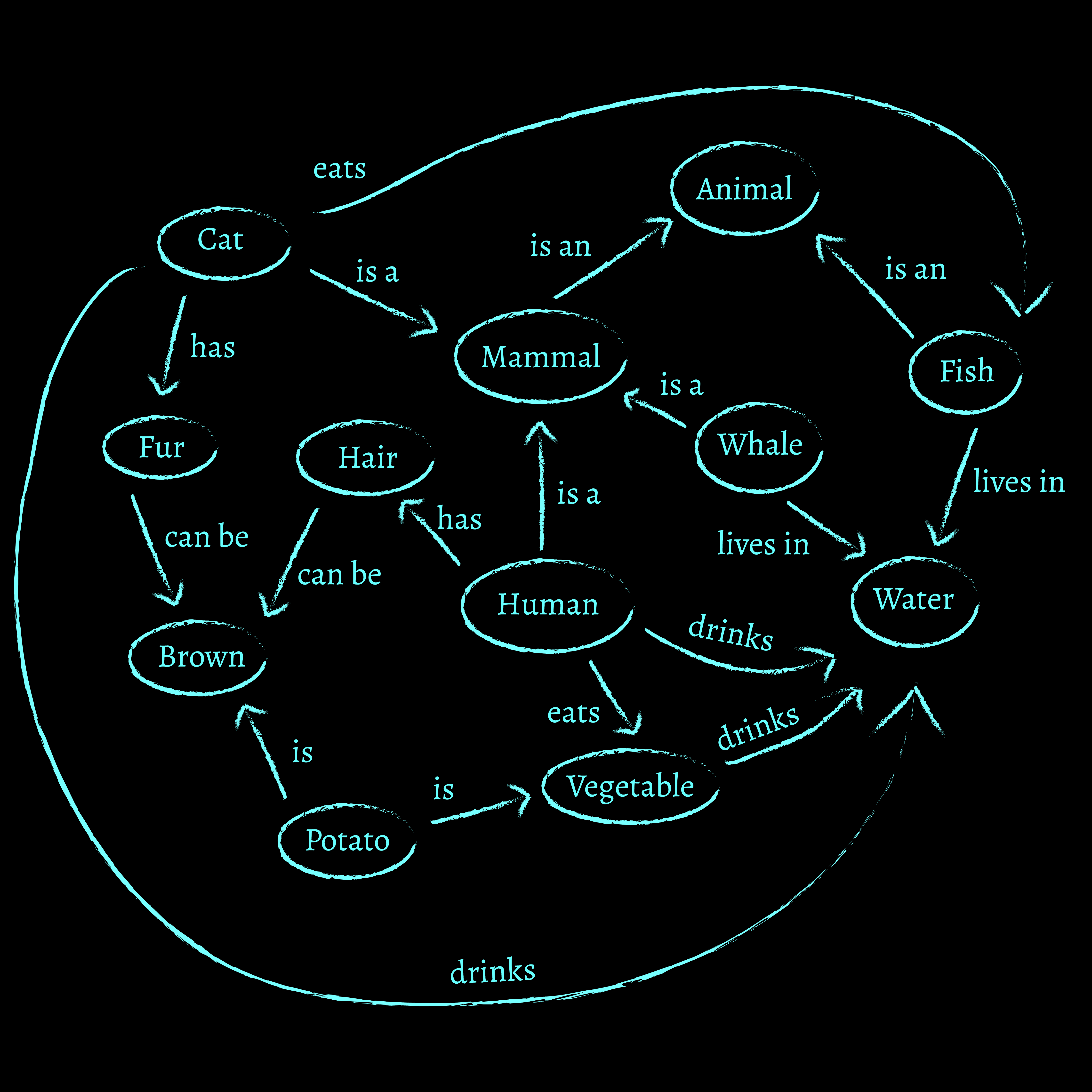
Above is an example of a semantic network. Following the map laid out, it can show how a mind can wander from subject to subject. Thinking about what a cat eats may lead you to fish, considering what a fish is may lead you to think about animals, and from animals, you go into deeper taxonomy and think about mammals, thinking about it, you self-reflect on humans, and their possible hair colours, which leads you to brown as a possibility, what’s also brown? Potatoes, and they’re a vegetable, and vegetables need water, and what lives in what water? Fishes. What likes to eat fish? Well, cats do.
The connections between concepts, even if they are far apart, are crucial to understanding ideasthesia and its implications. While these connections are on a cognitive level, they may be on a conscious or subconscious level. Different minds may orient these networks differently. E.g someone can associate the letter C with cats, and cats with the colour brown because their fur might be brown. Another person may also associate the letter C with cats, but instinctively moves further away from it, and associates it with the fishy breath they woke up face to face with one night, and unconsciously thinks about where fish live, associating the letter C with water and its stereotypical blue colour. Both minds trigger the sensory experience of viewing the letter C in colour, but in different colours because of their personal associations with the concept of the letter C and their personal semantic connections to it.
Understanding that concepts are intricate networks of attributed meaning is only a part of ideasthesia, and its possible implications. To better understand ideasthesia, let’s look at a famous example from the 1920’s called the Bouba-Kiki effect.
The Bouba-Kiki Effect
This experiment shows a mental association between certain speech sounds and certain visual shapes. The most typical research finding is that people, when presented with nonsensical words, tend to associate some with a spiky shape and others with a round shape. Looking at the example of the two figures below, which one would you call Bouba and which one would you call Kiki? What about Takete and Maluma?
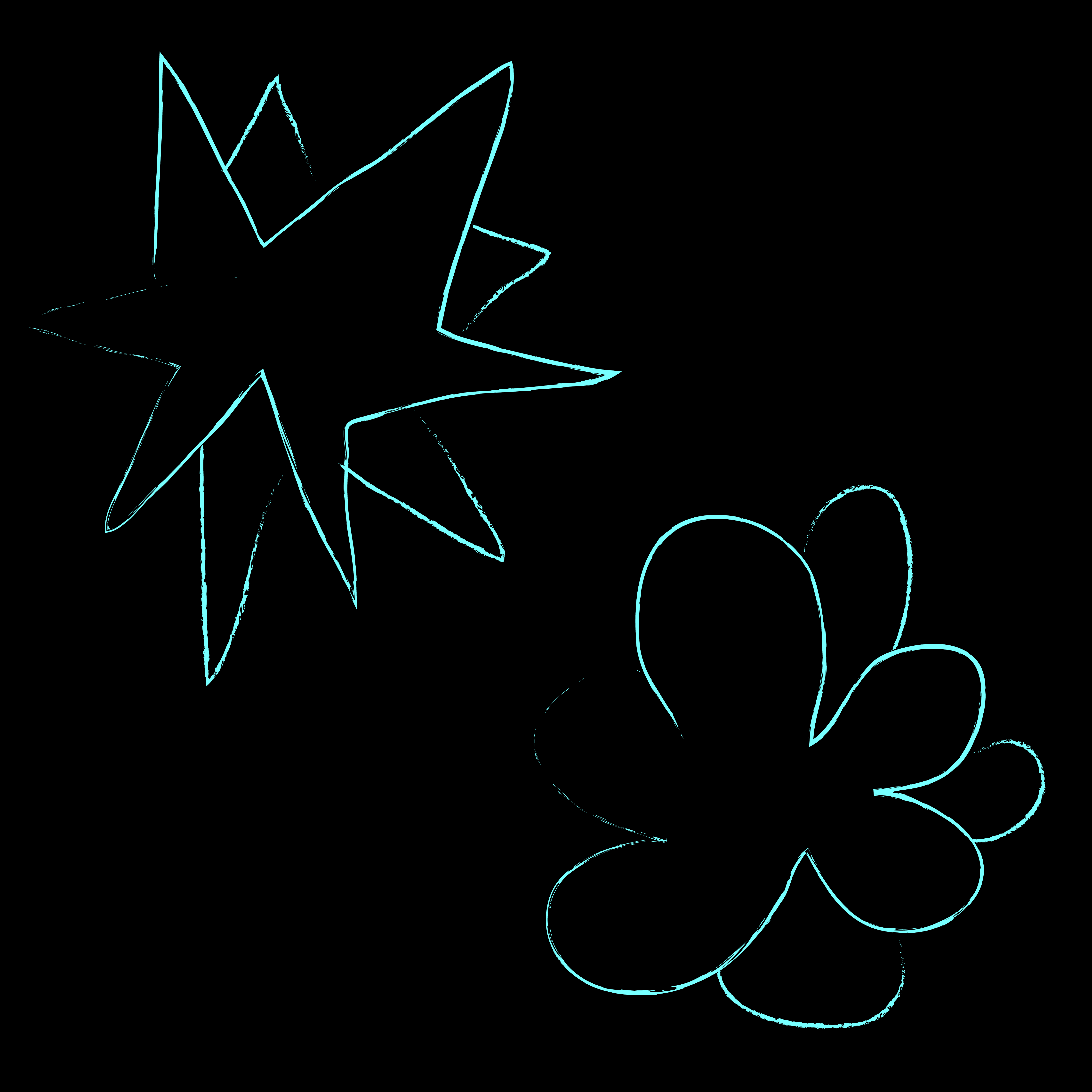
Statistically, it’s likely you agree with the strong general tendency towards the Bouba-Kiki effect. That is, the spikier one is called Kiki or Takete, and the rounder one is called Bouba or Maluma. This discovery was made all the way back in the 1920’s, when psychologists documented participants as connecting nonsense words to shapes in a very consistent manner.
Across languages and cultures worldwide, participants tend to label the spiky shape Kiki and the round shape Bouba. Research has included English-speaking American university students, Tamil speakers in India, speakers of certain languages with no writing system, young children, infants and even a small-scale experiment of the congenitally blind.
Additionally, and linking the experiment with ideasthesia, more research has found that there are more associations than just either word and either image and both are semantically associated with a wider scale of concepts like black and white colour, feminine and masculine, cold and hot and more.
As an example, both “Kiki” the word and the star-shape are viewed as clever, small, thin, and nervous. This shows that there is a richer semantic network behind both image and word. Some connections might be more obvious when looking at the shapes alone, but others might be a little more obtuse. Nervousness could come from the association of fragility; fragile being linked to associations of thin, like icicles or thin sticks that are easily snapped between the fingers. This shows that our sensory experiences are largely determined by the meaning we assign to the stimuli.
Another example of this is food description and wine tasting, both are domains where ideasthetic association between flavour and other modalities, such as shape, play an important role. The wine has a “round” flavour, or the food might “peak” your interest through piquancy. Waiters and sommeliers alike are trained not just through tasting but also linguistically and semantically to describe the flavours, not only in terms of flavour but other modalities. To enrich and deepen the sensory experience of the guests they’re serving.
People who enjoy muk-bangs or cooking shows in general know the importance of language when it comes to transmitting the sensory experience of tasting a meal through a screen. A good food reviewer is not only able to discern and distinguish cooking techniques and ingredients, but also to express them semantically and correctly using language. In this way, they can, through linguistics, partially impart a sensory experience on somebody who is not present there to taste or to smell the food. This strong thinking (semantic) and strong experiencing (sensory) is at the core of good art, and striking a balance between these might teach us how we’re able to invoke sensory experiences using semantic and symbolic associations.
These semantic-like relations play an important role, and there are generally agreed-upon meanings and understandings of these semantic definitions. This relation between the semantic and the sensory also extends to, and has implications in, the realm of art.
Ideasthesia in Art Theory
There’s a plethora of approaches to quantifying and labelling art. What it is, how it is and where it is. There has never, and probably never will be, a unified scientific point of view on human art and culture. There can never exist a general classification of art that applies to each and all individuals. That hasn’t stopped us before, and it’s not going to stop us now, however. We love discussing matters of taste, and we love theorising, and perhaps in all of that experimental thinking, we find some golden nuggets of wisdom which we can apply to our lives and our creative process.
The relation to ideasthesia and aesthetics is that of a balancing act. Art can be too intellectual, and lose all sense of a sensory experience, or it can be the complete opposite, being overwhelmingly sensual with nothing to say. This is especially true when we consider more abstract styles of art. Abstraction, which itself relies heavily on conceptual thinking, is best when it treads that fine line of linking semantics with the sensory, or when it is in harmonious ideasthesia - balancing idea with aesthesia.
Art is very unique in its ability to evoke strong emotional experiences (sadness, joy, fear, etc.) that are fully sensed, but also to evoke strong cognitive states (recall, memory, contemplation, reflection etc.) This is true for all kinds of arts, auditory, visual, etc. The senses can be moved and triggered to react, evoking these states in the viewer. Understanding the relations between the cognitive nature of semantics and the sensory nature of emotions can help bridge the gap between the two and create art which is understood even if abstract. Wasilly Kandinsky was a Russian painter whose work was heavily inspired by both theory and abstraction. He was both an artistic and spiritual theorist and wrote about synesthesia, amongst other topics.
He developed a theory of geometric figures and their relationships, e.g., claiming that the circle is the most peaceful shape and represents the human soul. Many of Kandinsky’s theories have later been studied and researched, and one of them is the natural association between angles and colours. Conducted at the University of Trento by Liliana Albertazzi, this experiment set out to find if there is a perceived hue to angles. Choosing from the natural colour hue circle, participants were asked to pick a colour that they perceived most closely related to a specific angle - angles formed by two segments joined at their vertex and varied in width.
The study confirmed Kandinsky’s hypothesis and the participants systematically established a natural and consistent association between certain angles and colours. Acute angles were perceived as warm and obtuse angles as cool colours. The strongest relations were found between the angle of 22.5° and yellows, the angles of 45°, 90° and 135° and green-yellows and the angle of 157.5° and red-blues when the angles were presented on a white background. Kandinsky was a devout Orthodox Christian and often drew upon biblical narratives as well as Russian folktales and myths, which could explain some of the semantic relations in his network of perceived things. Kandinsky called himself a synesthete, but it’s impossible to tell how much of his synesthesia was in fact influenced by semantics. Drawing upon as rich a cultural history as he did, there is bound to have been a semantic influence and a sensory influence.
We can never be fully liberated from our language, from the culture we inherit and from the ideas that make their way into our minds. These words are powerful enough to evoke our senses on their own, as studies on synesthetes have found. People have a sensory experience as soon as the concept is triggered. For example, a common form of synesthesia is the association between graphemes (letters/numbers) and colour. It’s not necessary for most synesthetes to see the visual representation of the grapheme to induce a sensation of colour, and for an ambiguous sensory stimulus like a “5” representing “5” or “s”, the context in which it’s presented changes the sensory reaction. Put amongst numbers, the ambiguous grapheme elicits a different response than when put amongst letters.
Ideasthesia as a concept holds a lot of value not only in art theory, but everyday perception, and to understand it is to understand a bit better how human consciousness works. A lot of phenomena we previously attributed to synesthesia can, in fact, be attributed to ideasthesia, and it highlights the power language holds over our perceived reality, not only personally but also collectively.
Final Words
Sensing concepts play an important role in how we not only perceive but also interact with the world, and it shapes our sensory experience more than we might have previously thought. Whereas synesthesia describes two sensory experiences being closely interlinked or in “union”, causing the two wires to cross and produce two simultaneous sensory experiences from one sensory trigger. Ideasthesia states that a sensory experience may be triggered as soon as a concept is activated cognitively.
There are many examples of ideasthesia, especially in synesthesia experiences, where research has shown that a semantic activation is usually all it takes to induce a sensory experience previously attributed to synesthesia. One thing I didn’t fit in to talk about is the implications ideasthesia has on the development of synesthesia.
Synesthesia is more common among children and seems to fade as we grow older. Synesthetic children may associate sensory-like experiences as a more tangible way to first grasp and understand more abstract concepts. There’s a hypothesis called the “semantic vacuum hypothesis” that states that synesthesia is used as a cognitive tool to cope with the abstract nature of learning materials imposed upon children. This hypothesis would explain why the most common inducers in synesthesia are graphemes and time units, both relating to the first truly abstract ideas that a child may encounter in their upbringing.
Sensory experiences are easier to understand, you see them, you feel them and some you can touch. But semantic experiences need to be understood cognitively, and as a way for the developing mind to better understand them, it turns those semantic experiences into sensory ones to more easily grasp them. Ideasthesia is a rich concept that has implications far beyond child psychology, and understanding it may help us better understand how we understand the world, and they give us a glimpse into the complex semantic networks our brains operate in.
Semantic networks are cognitive maps that show us how words, concepts and ideas may interlink. Usually things aren’t that many “steps” from one another, and it can help us understand how we can associate certain shapes with certain colours, moods and so on. Even if things seem completely unrelated, there is a part of our cognitive side that connects the spiky shape with the name Kiki, and the round shape with the colour blue, which in turn we view as peaceful. Some artists have known this long before we were able to put it into words and concepts. Like Kadinsky, who intuitively experienced the round shape of a circle as the most peaceful of the shapes.
It’s perhaps in art theory that I find the most value in understanding ideasthesia. Because it not only describes but actively shows the power that concepts have. We might get bogged down in semantics and linguistics, but truly, art doesn’t need either to evoke feelings; it doesn’t need paragraphs upon paragraphs of text describing the sensation; it can simply evoke it using concepts. It’s easy to overlook this balancing act between the cognitive and sensory, and it’s easy to make it obtuse through language and words. When we see especially abstract art, it’s easy to think it is either too intellectual and semantic or too sensory. The ecstasy a painter experiences doesn’t always translate to the viewer, but to understand what concepts evoke what sensory experience, the artist can get a little closer to translating the untranslatable and perhaps be able to fully transmit the sensation of eating chocolate, and not just provide a literary description of the sensation.


