
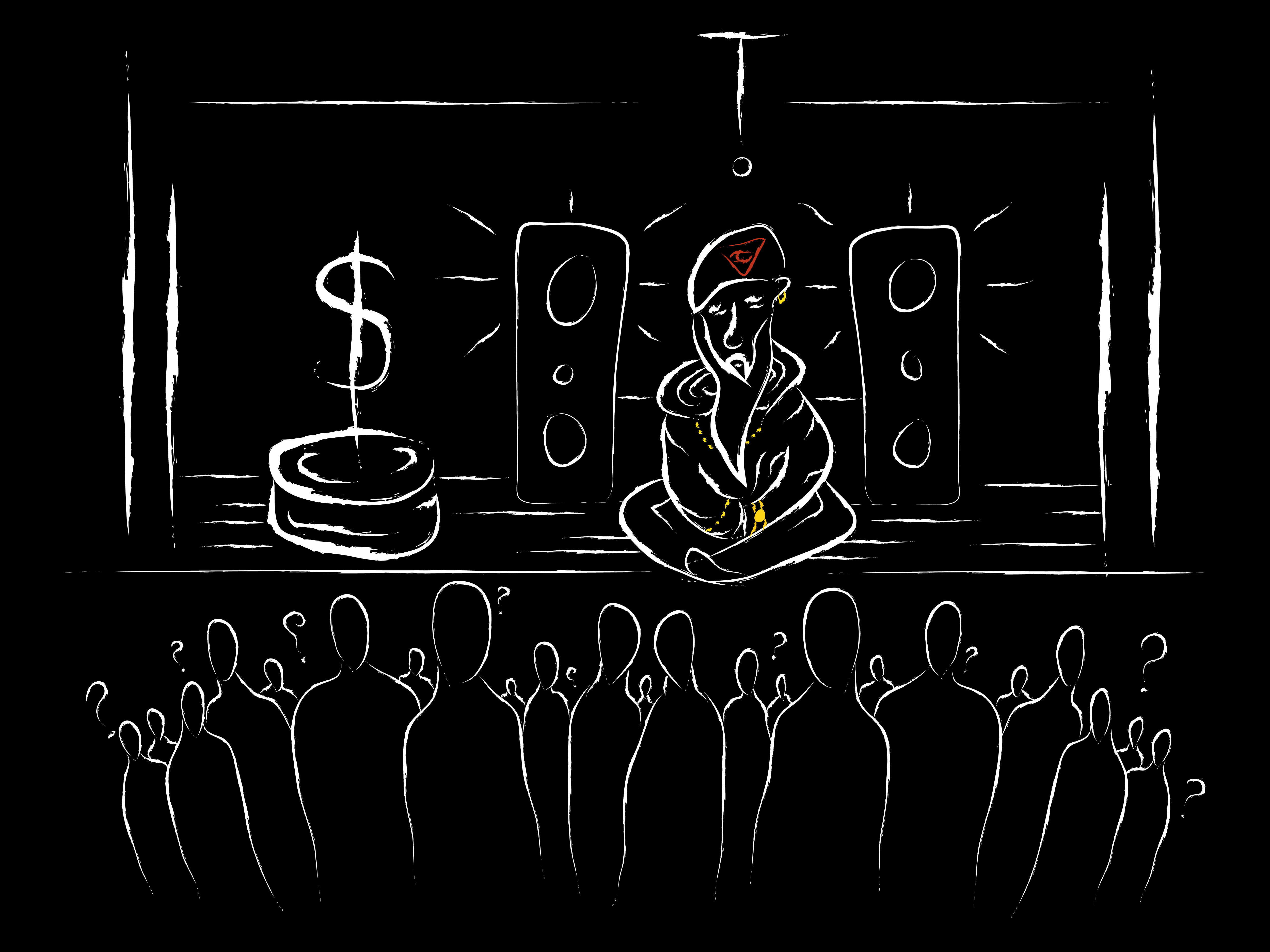
Festivals, Retreats and Commercial Spirituality
Introduction
Today, in the golden dusk of neoliberalism, everything not chained to a wall is sold off. Commodified and commercialised, everything from material to immaterial is sold. People trade their time, their bodies and their souls for a quick buck. Either as a necessity for survival or as a means of self-fulfilment, this has today become true for all aspects of life. Virtues like selflessness and discipline are only gained through expensive travel and luxurious resorts. We find ourselves incapable of pursuing anything ourselves, and we rely on gurus, influencers, and drugs to do the heavy lifting for us.
This highlights a problem a lot of us face, sometimes intellectually and at other times more sincerely. This problem is that we expect life, and also our faith and belief, to be external and to be so powerful that it would sweep us off our feet and, like a whirlwind, pull us up to heaven where the knowledge of the earth is revealed to our awakened minds. We expect to feel, and to realise through a tangible change in consciousness, to have all kinds of esoteric and profound arcane knowledge revealed through divine ecstasy.
This is why practices like breathwork, psychedelics and festivals have all come to be so popular with people searching. Contrary to meditation or prayer, these offer powerful and sometimes overwhelming experiences. Loud music, intense breathing and mind-altering drugs all offer a real sense of sensory, conscious implosion. They’re hypnotic, easily accessible and not abstract, and more importantly perhaps: they’re not boring.
When I was searching, I turned to some of these experiences, and they really are powerful, but much like a child who spins around to get dizzy, that change in consciousness requires different work, and repeated drum circles, ayahuasca retreats and expensive festivals are temporary, and perhaps more importantly: echochambers. There’s no criticism, and people revel in toxic positivity and are keen to brag about the retreats they went to last year, or the ones they’re planning to go to, and they will rave madly about how it changed them, but ultimately, they remain the same, and they are homogenous in their subculture. It’s human nature after all. People also make it personal when there’s a risk attached, and when we spend money on something we don’t want to be perceived as fools or feel as if we’ve wasted such a precious resource. So people grasp firmly onto positivity, and they surround themselves with people who reaffirm their spending, and there is a lot of spending.
Retreats, festivals and coaching are all multi-billion-dollar industries; they’re heavily advertised and pushed in our culture. A rich and bloody irony has killed the grassroots of these movements, and alternatives can be difficult to find, especially if you find yourself in such an echochamber. However, the seeker is the finder, and with my spiritual thirst haunting me, I was left still searching, and I really didn’t come across an alternative until I started delving deeper into the mysticism and traditions of the eastern-orthodox church. It sounds stupid and simple, but the truth of the orthodox mystic is that spirituality isn’t found in the sensory, but in the quiet.
Contemplative prayer, more akin to what is called meditation in the further east, is a spiritual practice that relies on the philosophy that less is more. In abstinence is abundance, and it declares clearly that the commercial and sensory is hypnotic and demonic. That these practices are nothing more than showmanship and the art of conmen. Divinity is something so powerful that the only way to begin conceiving it is through conceiving nothingness, and in that stillness, the fullness is revealed. In a journey for finding yourself, how can you expect to find yourself when you’re surrounded by others?
Solitude and Spiritual Depth
The entire Work isn’t lonely, but some parts are necessarily solitary. I can’t put it any other way. One can spend as much time as one likes avoiding solitude - there’s plenty of distractions to be had in this day and age, but inevitably, you will be alone, and in that uncomfortable and dark environment are the perfect conditions for growth. After all, the origins of all flowers and plants are a seed planted in the dirt, but in that dirt they feel the warmth of the sun, and they grow towards it, always up, all the while the roots continue deeper below.
Spirituality is a very personal thing, and it’s something that doesn’t have to be cultivated through commercial means. Commercialising faith isn’t something new, however, but it has risen in popularity since the 20th century. New-age beliefs and self-help are both heavily commercial practices that rely on the practitioner to spend extensive amounts of money to keep up to date with themselves. You have to buy a lot of expensive books, coaching, attend meetings with similarly minded folks, and many of these subcultures are tainted by Ponzi schemes. If spirituality were only gained through commerce, then the catholic church would be the first to the pearly gates, and they would be the most enlightened amongst us. But businessmen are not the people who sit with profound truths, and there is nothing exclusive that any one teacher sits with, which you can only learn by opening your wallet.
There is a spiritual depth in solitude which opens an inner treasury of divine proportions that enriches the minds and hearts of those who seek it. There are great teachers, and meeting and listening to sages isn’t something inherently bad; we learn from others, and knowledge is never heavy to carry. However, we should approach it with a critical mind, and especially so when it is heavily commercialised, and we shouldn’t feel like we’re missing out because we don’t have the money to pay for festivals, retreats and coaching. Enjoy them for what they are - and share with the world willingly what you have learned, not for self-gain or financial reasons, but because the will to give is a profound practice in and of itself.
Enter your dank and dim cave willingly, and embrace the discomfort, learn to appreciate stillness and come to terms with life as it is: boring and plain, and when you can recognise the divine ecstasy in that, you won’t have to rely on external means. Your daily life doesn’t cease to be because you broke your mind on psychedelics, and festivals and retreats don’t last forever. After all, they’re small moments in space and time, and make up a very insignificant portion of your life. Recognising your spirituality in your daily life is much more significant, and taking the lessons of a moment in time and applying them to the following moments is much harder than continuing to distract oneself with new moments of glimpses into the reality of the world. There is a Buddhist saying:
“Before enlightenment, chop wood, carry water; after enlightenment, chop wood, carry water”
It shows that life continues onwards in its mundanity and normality, but to take that and to understand the wonderful marvel of every second is something holy. When you recognise divinity in nothingness, then everything is infused with that essence, and then you become immune to commerciality and become truly counter-cultural. When you become happy with less, you have more to be happy about.
Final Words
There’s nothing inherently wrong with festivals and retreats, of course, but it’s important to recognise that many of them are commercial and monetary means of selling spirituality as a commodity. Experiences cost, and hosting events isn’t something that can be done for free a lot of the time, and people should be compensated for their work. Use your own discernment and learn to rely on yourself to do things rather than have others do it for you.
Take the time to be alone and explore the depths of your boring mind. Just sit with it and see what you find out. If you’re interested in these movements, learn about their grassroots; there are plenty of free resources available, and don’t break your bank trying to figure life out. Find out the real price of spirituality.
That, of course, isn’t to say that you shouldn’t enjoy your festivals, and that momentary glimpses of divine madness can’t put you on the right track, but don’t be fooled by the extravagance and shimmering gold; learn to recognise the treasures in the mundane aspects of life as well.
Commercial spirituality is a symptom of capitalism and the free market, where everything is sold and commodified. Even the act of rebellion against that economic ideology is sold and commercialised, but that’s a falsehood. If you wish to truly and meaningfully engage with it, you have to decommercialise your life, including your faith and personal belief, whether religious or political. That takes self-reliance and resilience.
To practice spirituality, you don’t need coaches, gurus, crystals, books and other commodities; all you need is within yourself, and a helping hand may be helpful, a teacher can put you on the right path and be an invaluable guide in navigating the stormy seas of life, but preferably you can find a genuine teacher, and not somebody who is after your money. There are better uses for that money than spending it on yourself. Give to the needy and the poor, help your friends and use it as a resource to better the world, and by doing that, you are guaranteed to better yourself in the process.
Spend your money and your time wisely, don’t chase superficial highs and instead come to find the divine in the lows. This is much harder than it sounds, and nothing in life worthwhile is easy. It doesn’t have to be solitary and lonely, but some aspects are bound to be, and it’s better to make peace with that than to chase distractions endlessly. Don’t be afraid to be a human having a human experience; there is something extraordinary in that as well.


