
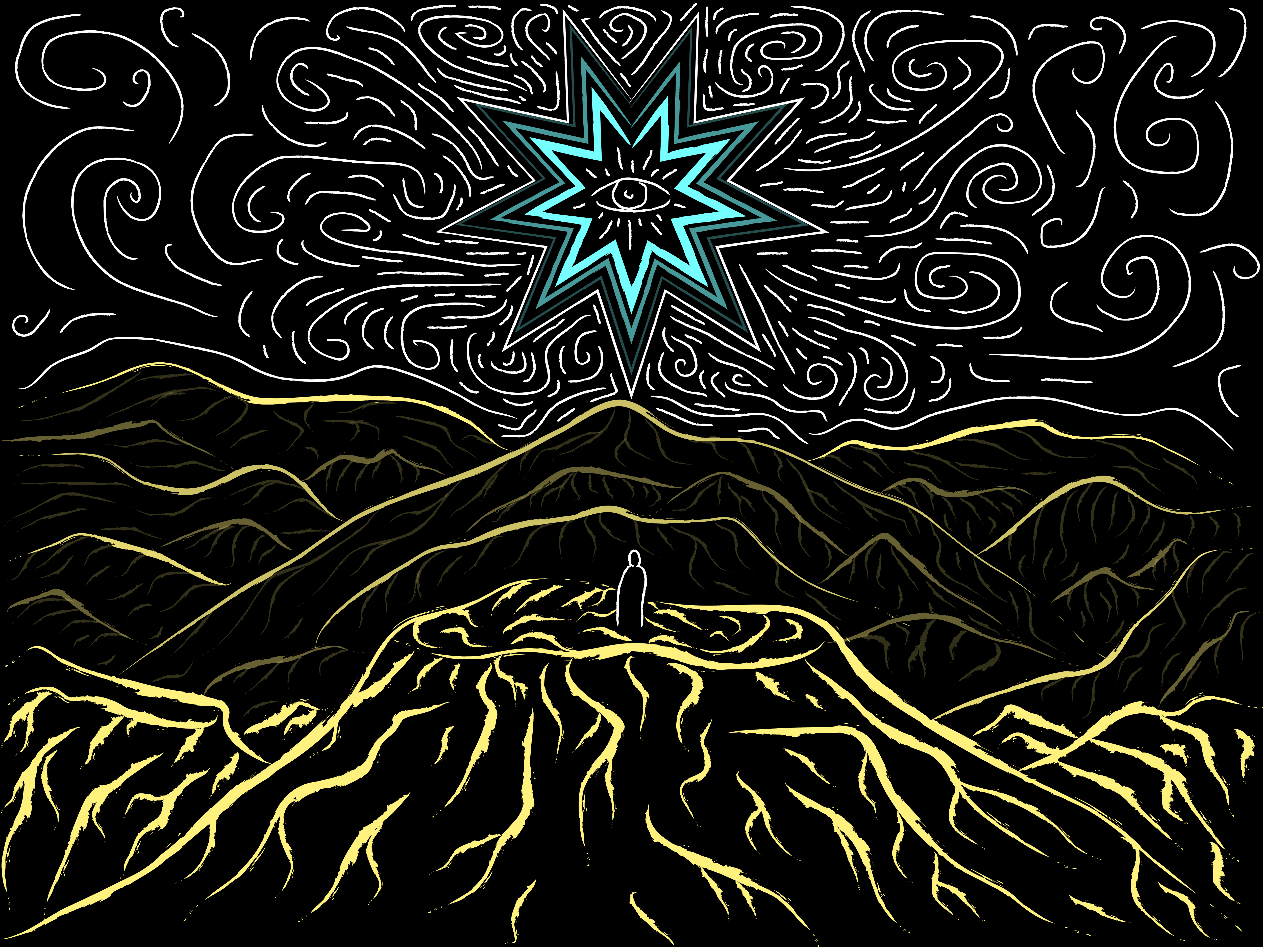
Dark Night of the Soul
Introduction - The Two Nights of St. John of the Cross
The term “Dark Night of the Soul” isn’t uncommon to come across today, and it’s found in various contexts. This text will examine more closely the origins of the term as well as its contemporary understanding, from psychology to mysticism. The term is sometimes used synonymously with a crisis of faith, but to the original author, St. John of the Cross, it was much more. It was a fundamental part of purification in the mystical development of the human spirit.
St. John of the Cross, born Juan de Yepes y Álvarez, was a Spanish Roman Catholic priest, mystic, poet and friar. He played an important role in the Counter-Reformation in Spain, and is held in regard by the Roman Catholic church to this day. He lived during the end of the 16th century and was officially canonised as a saint in 1726. John wrote two treatises about the Dark Night: Ascent of Mount Carmel and Dark Night. What we’re focusing on here, however, is the latter treatise called Dark Night (Noche Oscura), which is a commentary on his poem by the same name.
The poem narrates the journey of the soul to the mystical union with God. The dark night refers specifically to a part of that journey which is filled with confusion, helplessness, and doubt. The part of the journey is described as between illumination and full union - a state where the presence of God has been felt but is not complete. It’s a part where the soul is aware and knows of the presence of the Divine, but still has room to doubt. St John of the Cross describes it as an arid state, marked by stagnation of the will, and a sense of withdrawal from God’s presence.
It’s important to note that when we talk about the dark night of the soul, we often simplify the vision John had for his own writing. In fact, he describes two phases of purification which a soul passes through on its way to union with the Divine - he describes two dark nights.
The first being explained in his first treatise, Ascent of Mount Carmel, also called the Dark Night of the Sense. This occurs when God begins to lead a soul beyond simple meditation into mystical prayer, where the soul experiences God spiritually rather than through the senses. The first dark night deprives the soul of experiencing God through the typical senses, and moves it towards a more subtle and contemplative love. This purification strips away attachment to the lower faculties of the soul, namely the physical senses, imagination and emotions. This allows the soul to enter into a type of contemplative prayer devoid of sensory tricks, and the presence of God is felt spiritually rather than physically.
Whereas “regular” prayer can provide consolations and pleasant feelings, this dark night of the sense, removes such obstacles between the soul and God, and creates a love no longer dependent on these feelings or sensory experiences. The second night, the dark night of the spirit comes much later, and is far more intense according to John.
The Dark Night of the Spirit
The “true” dark night of the soul, is an intense spiritual purification which now removes the higher faculties of the soul - will, intellect and remembrance. The soul experiences a profound darkness - not because it has been abandoned by God, but because the Divine light is so overwhelming that it blinds the soul. Similarly to staring directly at the sun, the soul experiences a darkening of all else around it.
“The more clear and evident Divine things are, the more dark and hidden they are to the soul naturally. Thus … the stronger the sun’s rays, the more it blinds the visual organs; overcoming them by reason of their weakness, and depriving them of the power of seeing. So the divine light of contemplation, when it beats on the soul, not yet perfectly enlightened, causes spiritual darkness” (Dark Night, Book II, ch. 5).
John describes this purification as a burning away of even the most hidden imperfections, so that nothing remains except pure love. He uses the analogy of burning dirty oil, and that at first the flame also burns impure, but over time, those impurities burn away and the flame burns clean. The flame is symbolic of God’s love, which burns more purely after the dark night.
This dark night of the soul, is more than just a spiritual dryness; it’s not just a crisis of faith to John, it’s an all-encompassing purification of the soul, which prepares it for total union with God. It’s a surrender to the hidden purposes of the Divine will. According to John, man cannot attain the degree of purgation which is essential to his transformation in God on his own, but it requires Divine grace. He writes:
“However greatly the soul itself labours, it cannot actively purify itself so as to be in the least degree prepared for the Divine union of perfection of love, if God takes not its hand and purges it not in that dark fire.”
John also warns that great insight and discernment are required to recognise whether any given spiritual dryness is a result of this Night or whether it comes from sins, imperfections, frailty, or lukewarmness of the soul. He constantly highlights the difficulties and the challenges that are imposed on the soul during this dark night, but also the reasons behind it, and that ultimately, this seeming blindness of the spirit only serves to enlighten it again in a brighter and more intense light.
It’s little to no wonder then that such a vivid telling continues to inspire to this day. We may not all be monks, but most people go through an extremely intense, difficult and perhaps painful period in life, and just like St John of the Cross wrote hundreds of years ago, perhaps we’re better off for it.
Contemporary Reading
Today, the term is used more often to denote a crisis of faith or a spiritual darkness. In the modern secular world, a spiritual crisis like the dark night of the soul is often referred to as something more existential and interlinked to the individual rather than God. To a lot of people today, the dark night of the soul refers to a deep inner turmoil, and a battle with existential nihilism and even a confrontation with the negative sides of one’s own personality.
In Jungian analytical psychology, the term refers to a transformative experience where the individual confronts deep personal challenges, which leads to a psychological purification and a transformation Jung labelled as individuation - a process of self-discovery towards consciousness and towards emancipation of the true-self. Jung saw many parallels between this mystical concept of Christian theology and reimagined it in psychological terms. He saw it as a necessary disintegration which ultimately leads to a greater integration, this integration being a central concept to Jungian thought and ultimately the way individuation is achieved.
Jung, however, warned against the dangers of navigating this complex process without proper guidance - whether a therapist, spiritual master or a wise mentor, some kind of support is vital during this challenging period. Jung understood the dark night of the soul to be a pivotal phase in the process of individuation, which ultimately is a journey towards a more profound and integrated consciousness. It’s not easy, though, as he warned:
“There is no coming to consciousness without pain.”
Several other writers, psychologists, theologians and self-help coaches have continued to be drawn to the concept first coined by St. John of the Cross. While others have expanded upon it, and others have delved deeper into the concepts originally presented, for many, the very essence of the term can be summed up in the words of writer Joseph Campbell:
"The dark night of the soul comes just before revelation. When everything is lost, and all seems darkness, then comes the new life and all that is needed."
Final Words
There are some important distinctions between how the term is used today vs how St John of the Cross envisioned the dark night of the soul. At its core, we can see that there is some sort of fundamental understanding to it that we still understand to this day. What is noteworthy, however, is the secular context we view it in today. What was no ordinary spiritual crisis to its original author, it’s now informally used to denote a personal crisis, or a particularly difficult time in life. To John, the dark night of the soul, was something much more serious, because he knew we all go through crises and difficulties, and to him this kind of event was a fundamental part to the spiritual life, and a requirement for the total union with Divinity, which ascetics and mystics seek.
Whereas we often only talk about one night, John spoke of two, as both different phases of the same purification process. One which deals removes the soul’s lower faculties - the senses; and one which removes the soul’s higher faculties - intellect, memory and so on. Today, we can perhaps understand this as some sort of depression, or moment of doubt in a religious life, but John describes it as more: as no ordinary spiritual dryness.
The term is often appropriated by new-age movements and self-help coaches, and in many ways has been trivialised; it doesn’t carry with it the same weight as it did for St John of the Cross. He was quick to point out that this kind of situation was incredibly rare, and a guarantee for any devotee dedicating their life to the calling of Christ. Removed from its original and religious context, it can be difficult to grasp in its fullest sense. To John, the existential doubts and crises we face could be attributed to any of our own shortcomings, and not necessarily be the profound dark night he described.
Regardless of background and belief, the concept first coined by the Spanish mystic in the 16th century continues to inspire and guide people through life. Regardless of his original intentions and meanings, it is clear that the writing of St. John of the Cross has had a profound impact on believers and non-believers, and it has firmly cemented him and his writing as an important spiritual guide to many, whether that is to navigate the complexity of faith or just the overwhelming reality of life itself - what remains as true in his time as our time is the fact that after the dark night comes the radiant dawn.


