
A Lot to Look At - Nothing to See
Introduction - Minimalism & Maximalism
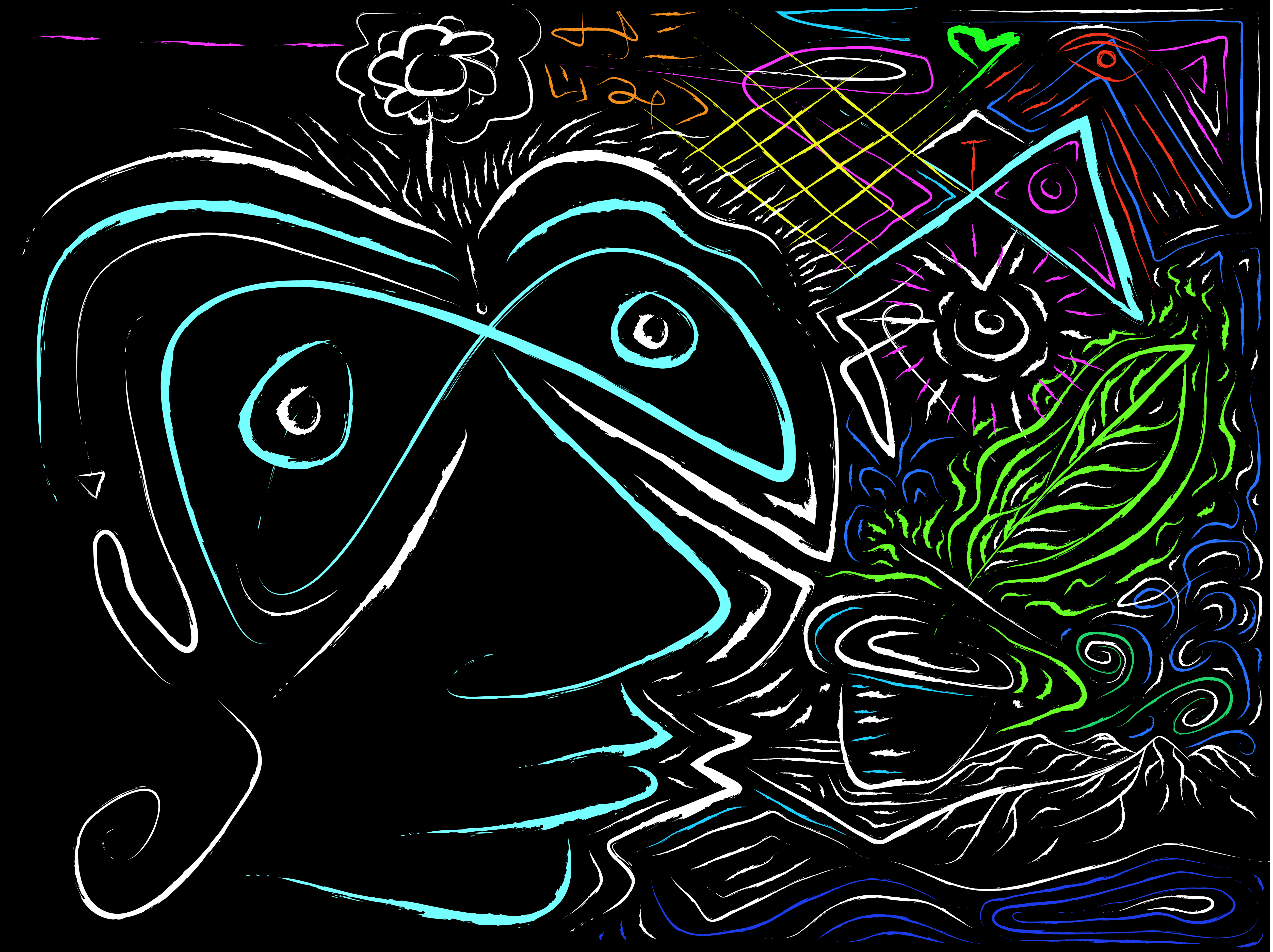
Minimalism is an art style that focuses on the idea that “less is more”, and focuses on reducing art down to its bare essentials. More than just an aesthetic, it’s a philosophy of life which is reminiscent of asceticism, and at its centre is a philosophy praising humility and a simple life. The opposite of minimalism is maximalism - a style characterised by exuberance and excess. In the visual arts, it’s often characterised by bold colours, intricate patterns and intense compositions embracing chaos and abundance. Personally, I am definitely guilty of cluttering my art with a lot of things. I do like bold and clear colours, and I like repeating patterns, and I’m certainly guilty of overworking a painting more than once. This blog post aims to reflect on the aesthetics of a lot, and comparing it to a little, as well as drawing parallels between the two and how we can find a middle way between minimalism and maximalism.
At their core, they’re two sides of the same coin, and both styles can be applied to a lot more than just the visual arts. Philosophically, I’m much more of a minimalist than a maximalist, but there’s definitely been a big dichotomy with that and how I dress and the art I make, but personally, that has never been a big paradox in my life. I’ve always seen a lot of common ground between the two. Both can say a whole lot of nothing if used incorrectly, and both can communicate profound truths about life. We often think the two as contradictory and that, as people, we have to choose one or the other, and that there is no world where the two coexist. Affirmed by life, this is true to some extent, but it also depends a lot on perspective. Understanding the two, their positives, their negatives and the philosophy at the bottom of both, we can begin to gain a fuller picture.
If we want a map for life, we don’t want it to be entirely minimalist, only showing us our starting position and our end goal - nor do we want it entirely cluttered with every minute detail. It helps us navigate if we can see landmarks, stops along the way and a third way between as little as possible and everything all at once. Nothing is of great importance, and understanding how to use the empty space, which is nothingness, allows an artist to convey great things through it. Both minimalism and maximalism can use nothing for good and for bad.
The Importance of Empty Space
Minimalism relies heavily on subtext and leaving things up to the observer. This is a fundamental aspect of literature, which makes great use of it, especially to build tension and to construct entire worlds in the mind of the reader. Here, the empty space allows the reader to fill in the blanks and to come to their own conclusion. A murder mystery is only satisfying if you get to solve it along with the detective, and leaving out details allows for speculation and implication. In rhetoric as well as music, silence is used for a similar dramatic effect. In the visual arts, empty space gives perspective, a sense of scale and much more. It similarly allows an observer to fill in blanks. What a lot of people don’t consider is that what we perceive as emptiness is often in fact maximalism filtered through our senses.
Consider the calm of an empty forest, or even a scene of a lone person in the desert. They’re surrounded by things! Sand, trees, animals, and so much else. The closest we get to a calm and sense of emptiness is often filled with so much detail that it becomes uniform in a way. The chaos of nature, when we shift our perspective and filter it through ourselves, becomes a great uniform droning noise. This droning noise is something I love, and while we can often view an orchestra of noise as something awful and distressing, if the notes fall in place, and in a slower rhythm, the maximalist noise can become a very calming background noise. I love a droning sound, not because I focus on all the frequencies of sound and experience every single one at a single time, but because it all comes together in unity. It’s order through chaos.
Ideally, this is how I try to use the style in my own art, as a droning background noise. Maximalist like the thousands of leaves that cover a single tree, or like distant landscapes from a mountain top that is far too much stuff for my eyes to pick up on and instead creates this optical illusion of minimalism. I believe this is how you can use maximalism to allow empty space, and to let single things shine. Both styles can say nothing if used incorrectly.
Leaving out too much makes art vague, uninteresting or simply unimaginative; not too different from a random splatter of paint across a canvas. For either style to work, they need to be balanced, and usually balanced against each other. One can say nothing by removing every second word, or adding two words in between; the empty space only fulfils its artistic purpose if used correctly. More as more is a little more difficult to pull off than less, especially visually. Maximalism tends to become visually cluttered.
Avoiding Visual Clutter
To understand how we can make use of a lot, without it becoming noisy or cluttered, we can turn to music and the droning noises we’ve discussed, and we can also ask the question why is doing nothing meditative or painful? The answer lies in ordering that chaos. Noise becomes meditative when it’s repetitive. Repeating rhythms, melodies, sound frequencies in the same range, and same timings allow things to become predictable, predictability is comfortability and has a calming effect on the mind. Meditation is the practice of observing nothingness. When doing nothing becomes boring, it can become stressful and agitating. But that depends on perspective and our own mental state. Even noise can become calming if we’re far enough from it.
In physics, when two waves are coherent and they are in phase, the two waves have a greater amplitude through constructive interference; meaning two different waves, when similar enough, amplify each other and come together to form a singular stronger wave. This idea of sameness is the key to maximalism and the meditative nature of it. Through repetition and sameness, we can do more with more.
Reducing asymmetries, sticking to limited and matching colour schemes and repeating patterns rather than creating new ones, is the trick to creating droning visual arts. In some ways, this is combining the philosophy of minimalism with maximalism. Instead of saying this painting will have a singular circle, we can determine that it will be circular, and through repeating the circle multiple times, they will phase together and amplify into a singular circle. While also reducing visual clutter. If you feel separated from nature, then it is chaotic, but if you feel a sameness, then it’s ordered perfectly.
Chaos and order are often about perspective. Chaos is uncomfortable because it’s incomprehensible, trying to make sense of it hurts your head, or it drives you mad, making connections where there are none. To reduce visual clutter and chaos, we can focus on limiting colours, symmetries and repeating rather than creating new shapes and new forms. Repetition makes it meditative, repetition makes it drone, and it’s the quality of hypnotic art.
Summary
We often view maximalism and minimalism as two contradicting aesthetic styles, but the truth is, there’s a lot the two have in common. Understanding how and when to apply either allows an artist to find a golden middle way between the two, where empty and background noise can reinforce and strengthen the main motif. Both styles have their strengths and weaknesses, and balancing any work of art with either requires careful consideration between the two.
Minimalism makes the most use out of empty space, and with the correct application, maximalism can become empty space. Through repetition and symmetry, discordant noise becomes a droning symphony of harmony; this is true for the visual arts as well. When applying maximalism or a lot of details in general, it’s important to remember this, and to limit colours, forms and to repeat rather than create new things - if that’s what you want.
When two things of the same come together, they leave minimalism and move towards maximalism - but at the same time, two waves coming together in phase create one bigger wave. In the same motion, more can move maximalism towards minimalism.
If not careful, it’s easy to overwork any piece of art. It’s easy to get tunnelvision and to get lost in the process. This can make an end result which is cluttered and difficult to comprehend. It makes it difficult to hear what the art piece is trying to say - just as saying nothing isn’t very helpful either. Striking a balance between the two is a cumbersome but worthwhile task. If done correctly, utilising maximalism allows one to turn chaos into order, and if we consider a different perspective, we can see that the two aren’t all that different.
Maximalism without restraint is abstraction for abstraction’s sake. It’s pretentious play, and it’s a lot to look at with nothing to see.


