
Thank you! Your submission has been received!
Oops! Something went wrong while submitting the form.
© 2023 Zevul's Arcanum. All rights reserved
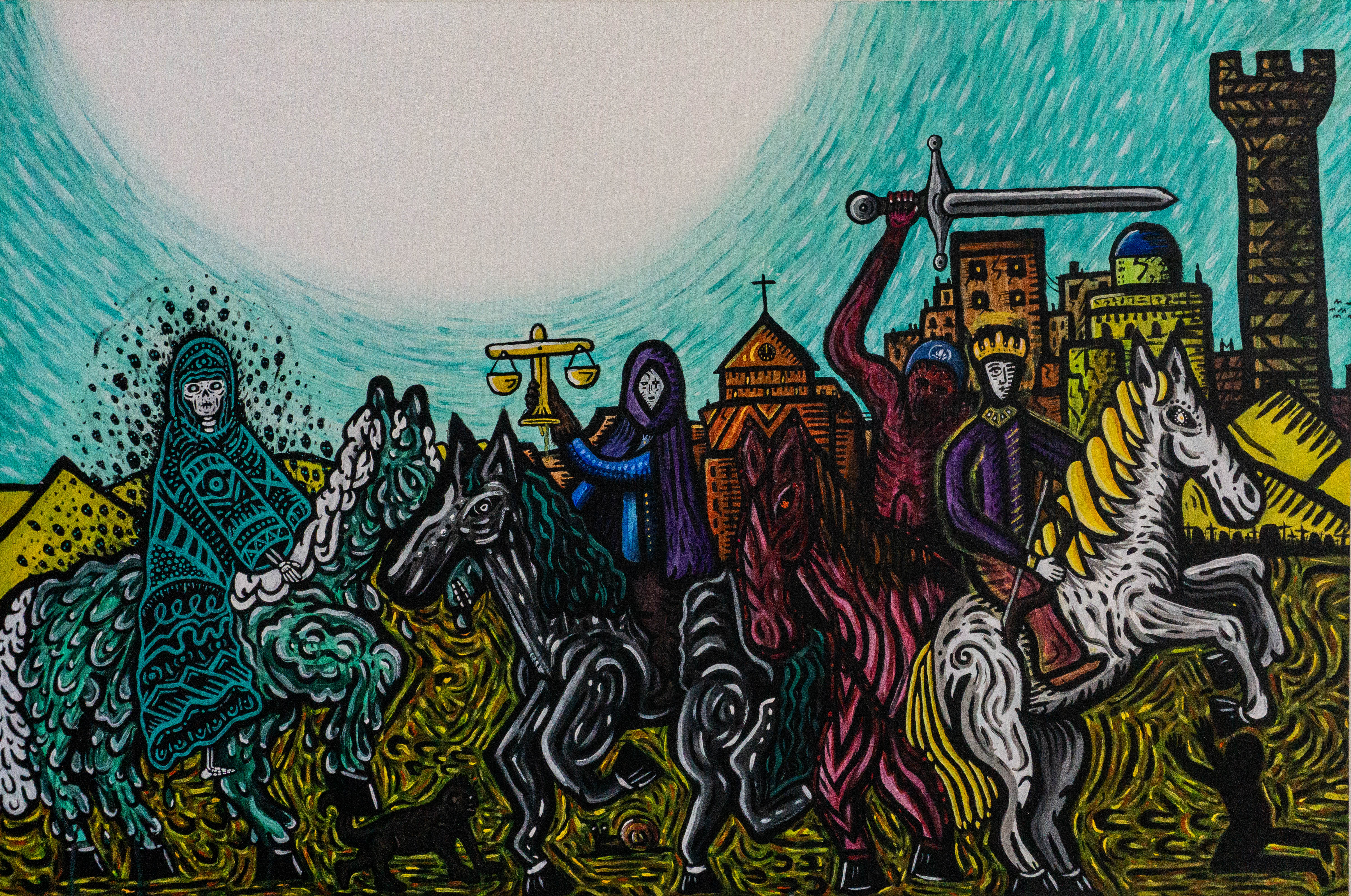
Acrylics on Canvas - 2026
Size: 120x80cm
Price: 1600€ / 17 765kr
Totally captured by another piece of art - “The Four Horsemen” by Aphrodite's Child was playing in my headphones for months as I was painting and planning out this painting. The four horsemen are figures in the Book of Revelation as part of the New Testament. In scripture only the fourth horseman is named, but they're often viewed as personifications of Conquest, War, Famine, and Death.
John of Patmos, the author of the text, describes the first horseman riding a white horse, carries a bow and wears a crown. The second rides a red horse and carries a sword. The third rides a black horse and carries a scale. Finally, the fourth horse is described as “pale”, in Greek the word “khlōrós” is used, which is the root word for the modern English word “chlorophyll” and “chlorine”. Based on this word and its usage in ancient Greek medical literature the colour is sometimes understood as a sickly green and sometimes even a green transparency. Therefore, in art historically the horse is typically distinctly green. Unlike the other three the fourth horseman is not described carrying anything but Hades follows him. Hades being the place of rest for departed souls and not the Greek pagan god and his abode. He is also the only horseman not depicted to be human-like.
In the Book of Revelation 7 seals are opened, as the Lamb of God opens the first four the horsemen appear, and despite being the central theme to the painting the other seals are also opened and depicted. As the 5th seal is opened the souls of the martyrs cry out and behold as their “fellow servants, brothers, and sisters were killed just as them”. Depicted as the man on his knees in front of the white horse. As the 6th seal is opened a terrible earthquake happens and all the stars fall out of the sky. In the painting there are cracks on several buildings and the brushstrokes are frantic and in constant moving, everything from the ground to the sky are shaking. The only peaceful and non-energetic space in the painting is the white in the upper-left corner, symbolising the 7th and final seal: complete silence in Heaven for about half an hour.
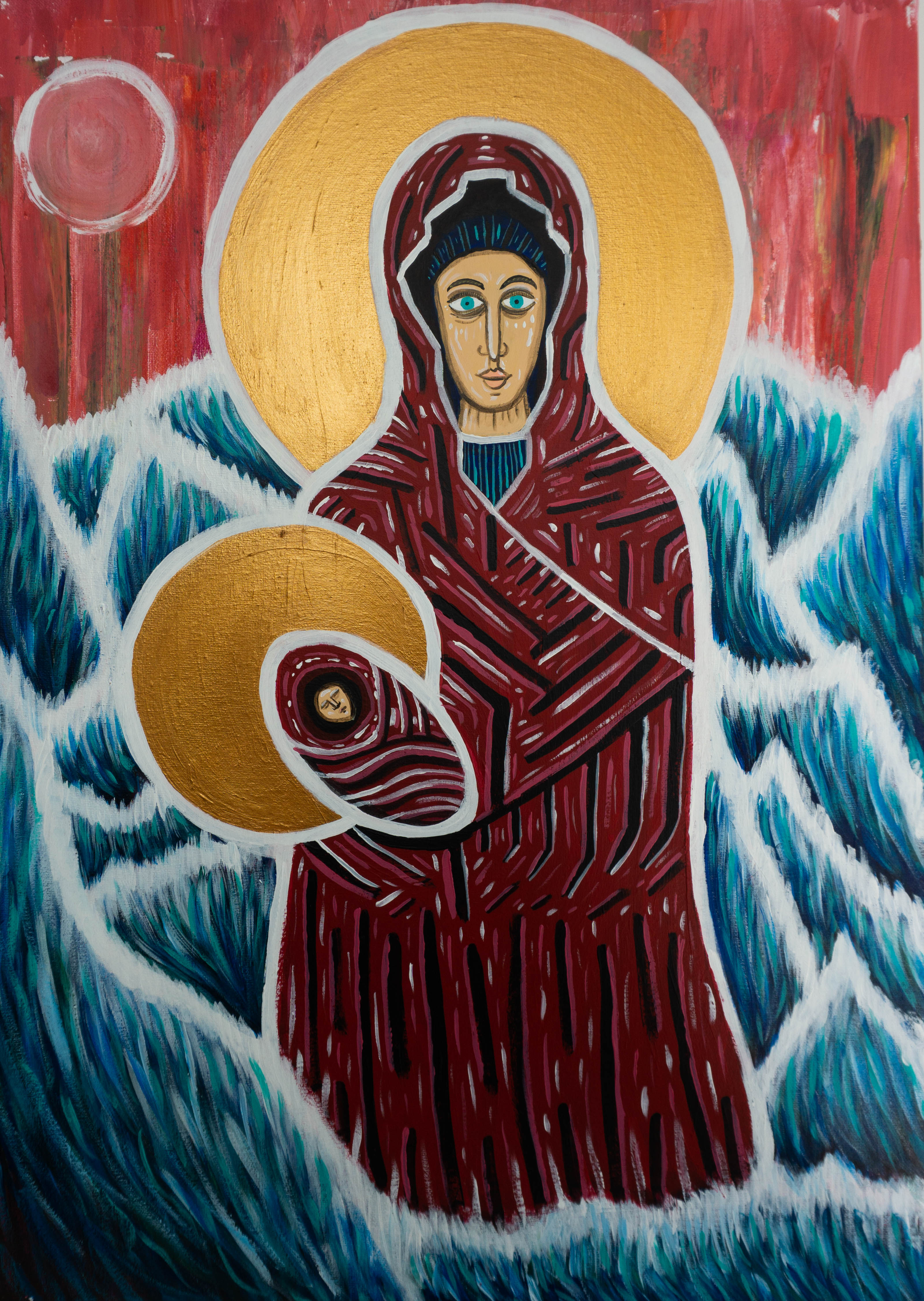
Acrylics on Canvas - 2026
Size: 50x70cm
*SOLD*
Madonna with child is one of the most prominent themes throughout art history, and it's actually one of the best-selling ones. I found this out way later after I began working on this one, and I did work on it for a very long time. It started way back in a summer house in Sweden and was eventually finished in Brussels years later. The main motif was always the same, but it took me years to get the faces right.
Observers often see Mary and Jesus, but in accordance with church tradition that can't be because of the Gloria around the baby. I like to believe it's no specific person, but a depiction of the contrasts found in motherhood and parenthood in general. Stormy seas, high mountain peaks, deep valleys, peace, blood, sacrifice and a certain atmosphere of divine mystery. There is a glory and a holiness, but it's a landscape which is barren and harsh. Jagged and sharp rocks or waves so big they could drown any ship. The child with its eyes closed are blissfully unaware of its surroundings and its mother stands in the middle of this landscape fully draped in an armour of textile, wrapped both around herself and her babe. There is a peace and a serenity in her face despite the challenges.
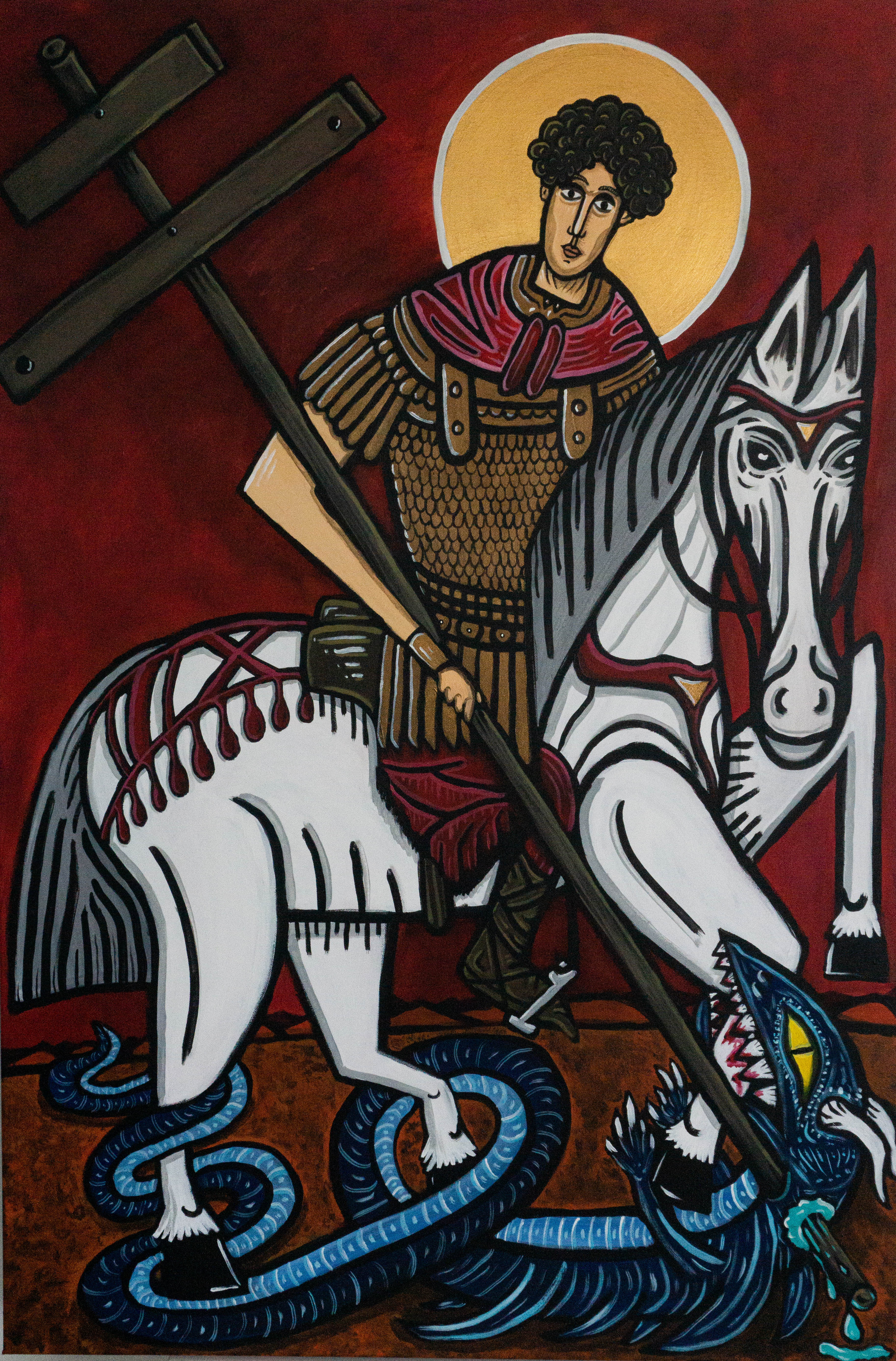
Acrylics on Canvas - 2026
Size: 80x120cm
*SOLD*
I was playing a game of Civilization 5 with my good friend, a game in which your kingdom can acquire great works of art. When the painting by Bernardo Martorell came on the screen I knew immediately what I had to do. It's a motif I've been very familiar with for a very long time, and I can't say I found Martorell's rendition particularly inspiring, alas I knew that I wanted to paint the saint slaying the dragon.
It's deeply inspired by the Byzantine style of iconography, but I want it to be clear that it is not an icon. I hold immense respect for iconography and consider it something much more than art, nonetheless the motif felt plain visually in any other aesthetic, and so it is inspired but rendered through my own lens, style, and technique.
Rather than giving the soldier saint the typical spear I approached it in a more allegorical sense and gave St. George a cross which pierces the dragon. According to tradition St. George was a Roman soldier, and so is he wearing armour typical of that time. According to the legend as well when the dragon was slain the local king built a church on the ground the dragon was slain and a spring sprang forth whose water was believed to cure any ailment. Symbolic of this the dragon bleeds not a deep red but rather bright cyan water.


